Try, learn and adjust
Check participation and job search
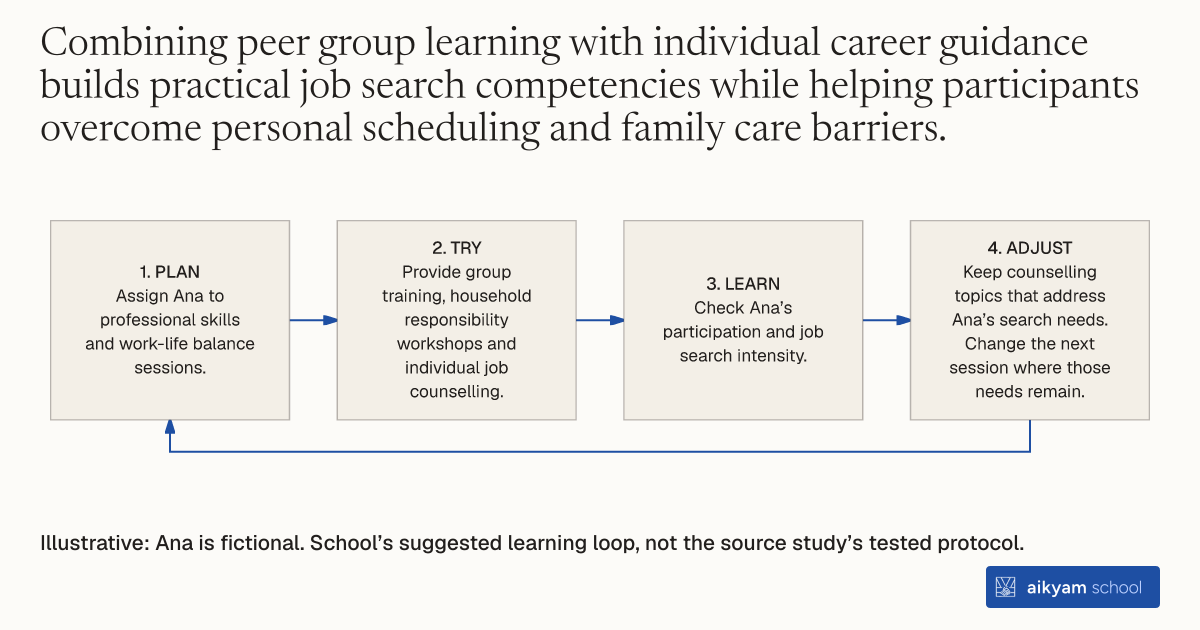
- Plan: Assign Ana to professional skills and work-life balance sessions.
- Try: Provide group training, household responsibility workshops and individual job counselling.
- Learn: Check Ana’s participation and job search intensity.
- Adjust: Keep counselling topics that address Ana’s search needs. Change the next session where those needs remain.
Illustrative: Ana is fictional. School’s suggested learning loop, not the source study’s tested protocol.
See source →School’s suggested learning loop, not the source’s tested procedure. Observe participation and job search intensity. The source reports no improvement in the overall employment and job search indicator or work income.
How
When to use
Minimum income recipient families face low employment rates and difficulty balancing household responsibilities with career development. Standard job counselling often overlooks how family care duties restrict workforce participation. This method delivers group-based training on work skills and life balance to help low-income adults enter the labor market.
Deliver group training sessions on professional skills and work-life balance alongside individual counselling for minimum income recipients.
- Program caseworkers assign adult family members receiving minimum income transfers to structured training groups.
- Instructors lead group sessions focused on developing core professional skills and career planning.
- Facilitators conduct dedicated workshops on managing work-life balance and household responsibilities.
- Employment advisors deliver individual job counselling sessions to tailor search strategies to each participant's needs.
Why it works
Addressing work-life balance directly increases job search intensity among vulnerable parents.
Example
The Government of Galicia in Spain provided group professional skills training, individual counselling, and work-life balance assistance to recipients among 2,359 families. Between 4 percent and 40 percent of participants engaged in the training and counselling activities over a nine-month period. The intervention increased participants' overall job search intensity.
About the study
Participants
2,359 families (1,060 treatment group, 1,299 comparison group) receiving minimum income schemes in Galicia, Spain.
Study Design
Randomised Controlled Trial (RCT) evaluating a 9-month inclusion program delivered by local non-governmental organisations under the Government of Galicia.
Results
The program increased participants' job search intensity, but did not enhance the overall indicator of employment and job search or income from work.