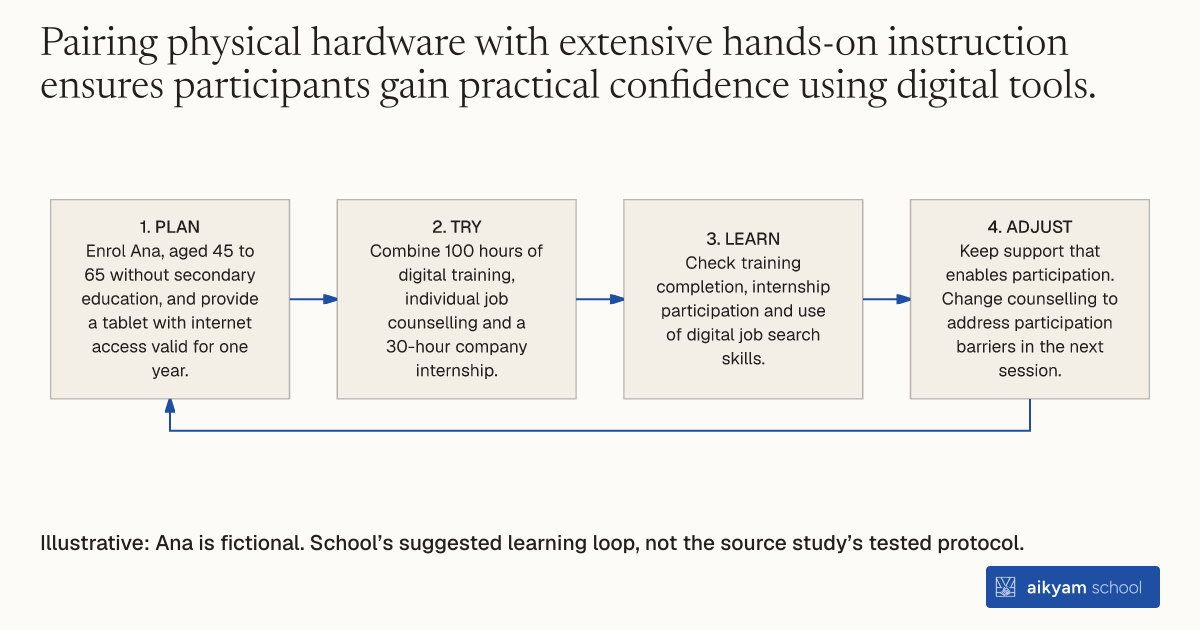
Try, learn and adjust
Check delivery of training and internship support
- Plan: Enrol Ana, aged 45 to 65 without secondary education, and provide a tablet with internet access valid for one year.
- Try: Combine 100 hours of digital training, individual job counselling and a 30-hour company internship.
- Learn: Check training completion, internship participation and use of digital job search skills.
- Adjust: Keep support that enables participation. Change counselling to address participation barriers in the next session.
Illustrative: Ana is fictional. School’s suggested learning loop, not the source study’s tested protocol.
See source →School’s suggested, untested loop: observe the combined package. Training completion was 42%; short-term employment rates did not improve.
How
When to use
Older low-income job seekers with low educational attainment face severe digital exclusion that limits access to online job portals and government services. Simple hardware distribution alone fails to build practical digital skills or improve job placement rates. This method combines hardware provision, intensive hands-on digital instruction, and a short corporate internship to improve employability among vulnerable older adults.
Combine digital hardware provision with intensive classroom digital training, job counselling, and a company internship for low-educated older job seekers.
- Social caseworkers select minimum income beneficiaries aged 45 to 65 without secondary education for digital inclusion.
- Program staff distribute a digital hardware kit containing an internet-connected tablet valid for one year.
- Instructors deliver 100 hours of in-person digital skills training focused on device operation, online administrative procedures, and active job searching.
- Employment advisors conduct individual job search counselling sessions to refine employment goals.
- Program staff place participants in a 30-hour corporate internship at a local host firm to apply acquired digital skills in a real workplace setting.
Why it works
Adding a workplace internship allows older job seekers to apply digital skills directly in professional environments, sustaining job search intensity over time.
Example
EAPN Canarias evaluated the Redlab program for minimum income recipients aged 45 to 65 without secondary education in the Canary Islands, Spain. Staff provided 994 participants with an internet-connected tablet, 100 hours of in-person digital training, job counseling, and a 30-hour corporate internship over five months. The intervention generated positive and durable impacts on digital skills, job search intensity, perceived ease of finding employment, and life satisfaction that persisted six months post-program.
About the study
Participants
2,968 minimum income scheme recipients aged 45–65 without secondary education in the Canary Islands, Spain (988 in digital kit group, 994 in RedLab combined group, 986 in comparison group).
Study Design
Randomised Controlled Trial (RCT) evaluating a 5-month intervention featuring a tablet kit, 100 hours of digital training, job counselling, and a 30-hour internship implemented by EAPN Canarias.
Results
The Redlab program had a positive and substantial impact on digital skills, job search intensity, respondents' perceived ease of finding employment, and life satisfaction persisting six months after the intervention ended, though 42 percent completed training and it did not enhance short-term employment rates.