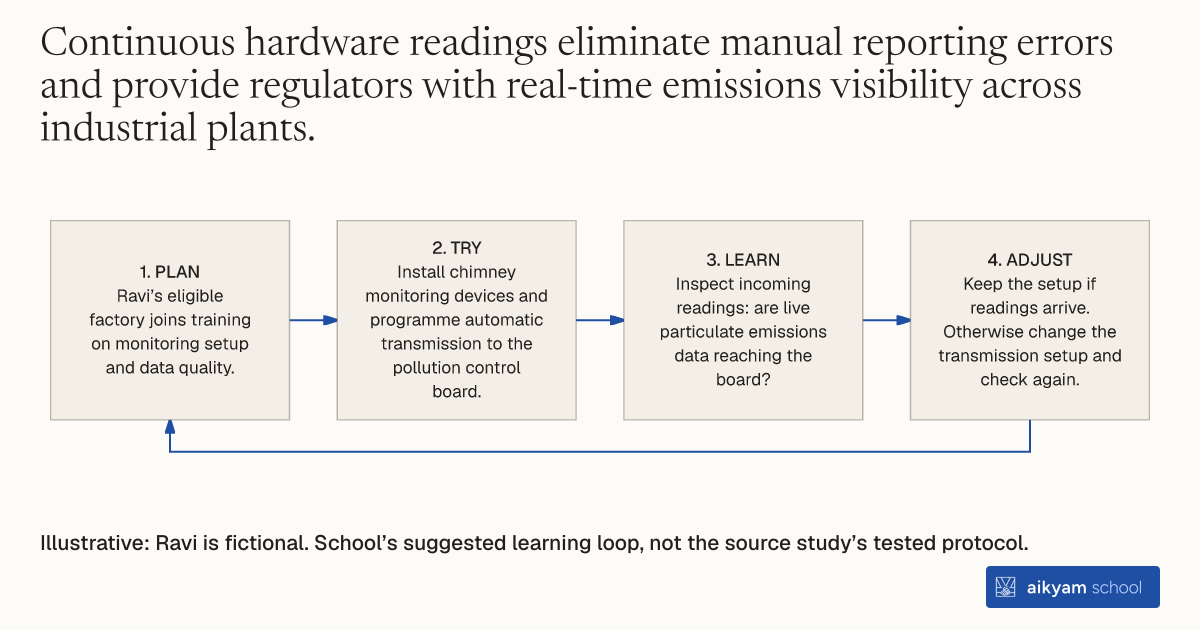
Try, learn and adjust
Check emissions readings reach regulators
- Plan: Ravi’s eligible factory joins training on monitoring setup and data quality.
- Try: Install chimney monitoring devices and programme automatic transmission to the pollution control board.
- Learn: Inspect incoming readings: are live particulate emissions data reaching the board?
- Adjust: Keep the setup if readings arrive. Otherwise change the transmission setup and check again.
Illustrative: Ravi is fictional. School’s suggested learning loop, not the source study’s tested protocol.
See source →School’s suggested learning loop: observe live readings and transmission; devices alone did not reduce emissions in the pilot.
How
When to use
Environmental regulators in polluted industrial regions face difficulty reliably monitoring continuous factory pollution. Standard manual audits and sporadic physical inspections miss smaller violations and fail to track ongoing stack outputs. Installing continuous emissions monitoring systems provides real-time pollution tracking on industrial smokestacks.
Mount continuous emissions monitoring hardware on industrial smokestacks to stream live pollution readings to regulatory central databases.
- Select eligible industrial manufacturing plants that consume solid fossil fuels, generate at least one ton of steam per hour, and possess sufficiently large chimney stacks.
- Conduct stakeholder training workshops to instruct factory managers on setting up devices, managing emissions accounting, and ensuring data quality.
- Attach continuous emissions monitoring systems devices directly to factory chimneys to capture live readings of particulate matter.
- Program devices to transmit continuous emissions readings automatically to central pollution control board servers.
Example
Environmental authorities in Gujarat, India installed continuous emissions monitoring devices across 292 industrial textile factories in Surat, establishing automated real-time particulate matter data collection for central pollution control databases.
About the study
Participants
292 small and medium industrial textile plants in Surat, Gujarat, India (156 market intervention plants and 136 comparison plants).
Study Design
Randomized Controlled Trial evaluating continuous emissions monitoring system installation and real-time data collection across 292 factories during ten compliance periods from September 2019 to April 2021.
Results
Continuous monitoring hardware successfully captured live emissions data across all 292 factories, though pilot data confirmed that installing devices alone without market incentives produced no reduction in emissions.