Research steps
Estimate health returns to walking
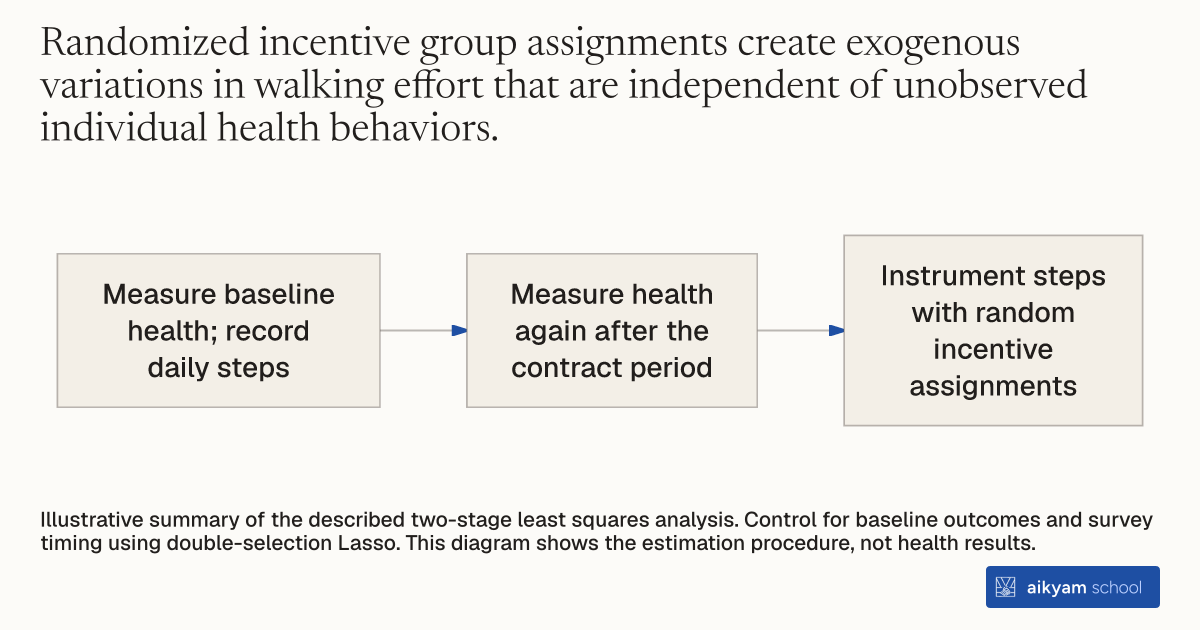
- Measure baseline health; record daily steps
- Measure health again after the contract period
- Instrument steps with random incentive assignments
Illustrative summary of the described two-stage least squares analysis. Control for baseline outcomes and survey timing using double-selection Lasso. This diagram shows the estimation procedure, not health results.
See source →How
When to use
Evaluating health programs often suffers from confounding because active participants may differ in unobserved ways like personal motivation or diet. Observed correlations between exercise and clinical health gains do not isolate true causal effects. Instrumental variables estimation solves this endogeneity by using randomized incentive group assignments to isolate exogenous changes in daily walking.
Measure the causal effect of exercise on health outcomes by instrumenting daily step counts with randomized incentive treatment assignments.
- Measure baseline clinical indicators including blood sugar, blood pressure, body mass index, and waist circumference during initial enrollment visits.
- Record daily step counts using digital pedometers across all randomized incentive treatment and monitoring control groups.
- Re-measure clinical health indicators during endline survey visits following the exercise contract period.
- Estimate a two-stage least squares model regressing endline health outcomes on average daily steps instrumented by incentive treatment assignment indicators.
- Control for baseline outcome values and survey timing using double-selection Lasso covariate selection.
Why it works
Two-stage least squares removes endogenous correlation, isolating the direct health impact of additional steps.
Example
Researchers in Coimbatore, Tamil Nadu, India, estimated instrumental variable health impacts for 1,520 adults with diabetes or hypertension, finding that each additional 1,000 daily steps reduced random blood sugar by 7.23 mg/dL in the full sample and by 12.5 mg/dL among participants with elevated baseline blood sugar.
About the study
Participants
1,520 participants with random blood sugar data (and up to 5,614 participants for blood pressure, BMI, and waist circumference) out of 6,882 enrolled adults aged 30 to 65 in urban Coimbatore, Tamil Nadu, India.
Study Design
Two-stage least squares instrumental variables regression within a randomized controlled trial, instrumenting average daily steps with incentive treatment indicators and controlling for baseline health variables.
Results
Each 1,000 additional daily steps reduced random blood sugar by 7.23 mg/dL (p-value 0.081) in the full sample and 12.5 mg/dL (p-value 0.081) among those with above-median blood sugar, while reducing waist circumference by 0.45 cm (p-value 0.081).