Research procedure
Estimate returns to farm inputs
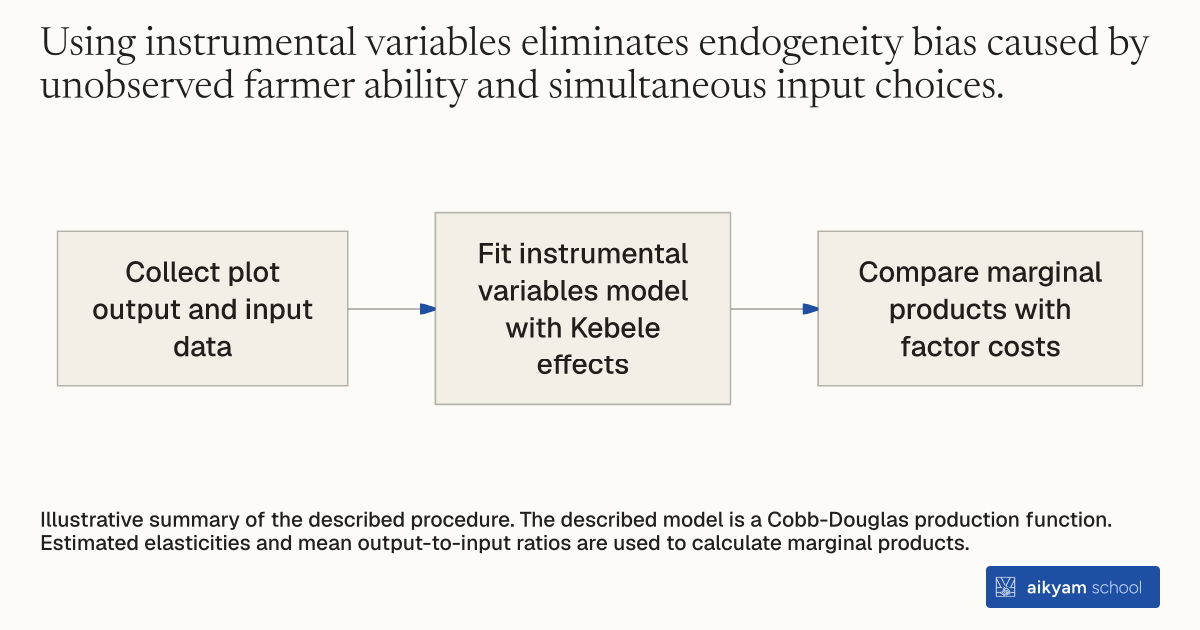
- Collect plot output and input data
- Fit instrumental variables model with Kebele effects
- Compare marginal products with factor costs
Illustrative summary of the described procedure. The described model is a Cobb-Douglas production function. Estimated elasticities and mean output-to-input ratios are used to calculate marginal products.
See source →How
When to use
Smallholder farmers in developing regions often underuse cash inputs like inorganic fertilizer, but standard production regressions suffer from endogeneity and omitted variable bias. Analysts need to calculate true factor marginal products to evaluate whether input expansion is profitable. Estimate an instrumental variables Cobb-Douglas crop production function to measure allocative efficiency across farm inputs.
Estimate a Cobb-Douglas crop production function using instrumental variables with village-fixed effects to calculate input marginal products.
- Collect plot-level baseline survey data on crop output value, cultivated area, family labor, agricultural capital, and purchased inputs.
- Formulate a Cobb-Douglas regression model relating log gross output value to logs of primary production factors and plot characteristics.
- Select exogenous instruments for endogenous labor and input variables, including credit constraint status, draft livestock holdings, bank account access, and local input prices.
- Run instrumental variables regressions with Kebele-fixed effects to obtain unbiased factor elasticities.
- Compute the value of marginal product for each factor using estimated elasticities and sample mean output-to-input ratios.
- Compare calculated marginal products against marginal factor costs to identify underused or overused production inputs.
Why it works
Comparing estimated marginal products to market factor costs reveals true allocative inefficiencies and guides targeted agricultural support policies.
Example
Researchers analyzed 2,232 smallholder households in Amhara, Ethiopia, estimating an instrumental variables Cobb-Douglas production function with Kebele-fixed effects. The regression revealed an input elasticity of 0.477 for purchased cash inputs and 0.827 for labor, demonstrating that purchased inputs were severely underutilized.
About the study
Participants
N = 2,232 rural smallholder households across 120 Kebeles in 4 zones of Amhara, Ethiopia.
Study Design
Instrumental variables (IV) Cobb-Douglas crop production function with Kebele-fixed effects, instrumenting labor and inputs using credit constraints, draft oxen, bank account ownership, and fertilizer prices.
Results
The value of marginal product for purchased inputs was 4.5 (statistically different from market price 1.0 at p < 0.05). The marginal product of labor was 484 Birr/month versus a market wage of 1,176 Birr/month (p < 0.01), confirming capital constraints and labor surplus.