Try, learn and adjust
Check training, inputs and psychosocial support are delivered
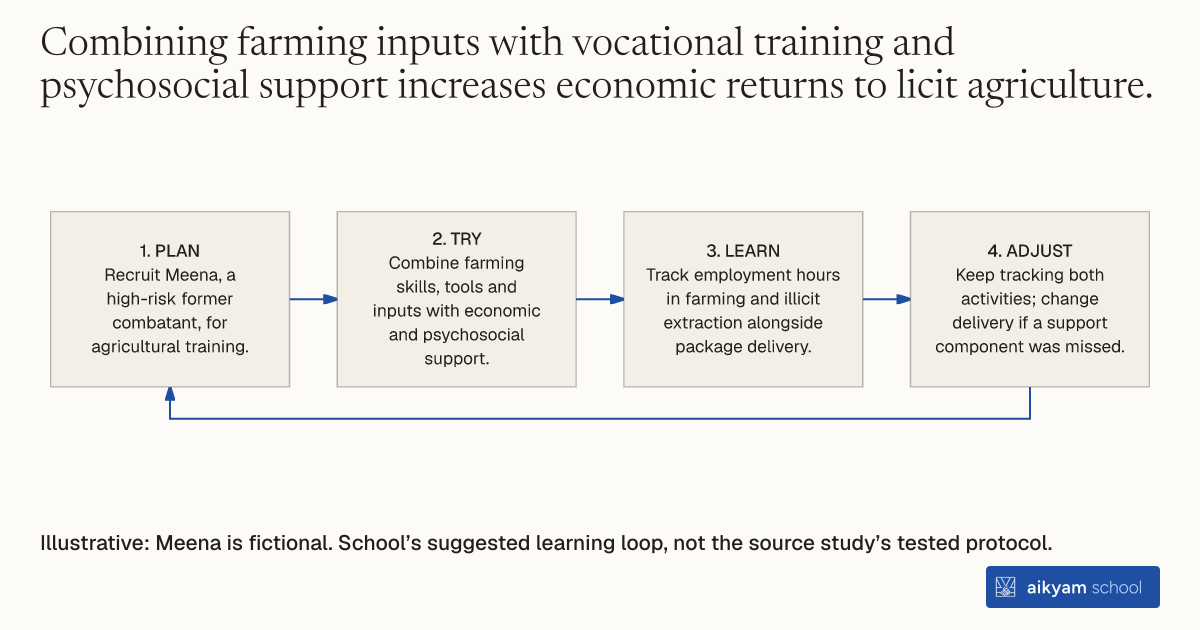
- Plan: Recruit Meena, a high-risk former combatant, for agricultural training.
- Try: Combine farming skills, tools and inputs with economic and psychosocial support.
- Learn: Track employment hours in farming and illicit extraction alongside package delivery.
- Adjust: Keep tracking both activities; change delivery if a support component was missed.
Illustrative: Meena is fictional. School’s suggested learning loop, not the source study’s tested protocol.
See source →Package delivery and hours by activity; do not attribute the combined programme’s effects to one component. School’s suggested learning loop, not a source-tested cycle.
How
When to use
High-risk former combatants in fragile post-conflict states face persistent poverty and lack licit economic opportunities. Unemployed ex-combatants often engage in illicit activities like unlicensed mining, logging, or mercenary recruitment, which fuels regional instability and environmental degradation. This method applies to peacebuilding organizations seeking to reintegrate high-risk individuals into agricultural livelihoods.
Provide high-risk former combatants with intensive agricultural training that combines human capital, physical capital, and psychosocial assistance.
- Program managers recruit high-risk former combatants residing in fragile post-conflict regions.
- Instructors deliver intensive vocational agricultural training to build farming skills and human capital.
- Program officers distribute physical capital, including farming tools and agricultural inputs, to participants.
- Counselors integrate psychosocial assistance and economic support to facilitate sociopolitical integration.
- Program staff track employment hours in licit farming versus illicit extraction activities in Liberia.
Why it works
Higher agricultural earnings reduce the time high-risk individuals spend on illegal resource extraction or mercenary recruitment.
Example
In Liberia, an intensive agricultural training program provided human and physical capital alongside psychosocial assistance to former civil war combatants, increasing their agricultural employment and wealth while decreasing time spent in illicit activities.
About the study
Participants
High-risk men and former civil war combatants in Liberia.
Study Design
Randomized field experiment evaluating an intensive agricultural training program integrating human and physical capital with economic and psychosocial assistance.
Results
The program increased participants' agricultural employment and average wealth, decreased time spent in illicit activities like unlicensed mining, rubber tapping, and logging, and lowered interest in mercenary recruitment related to conflict in Côte d'Ivoire.