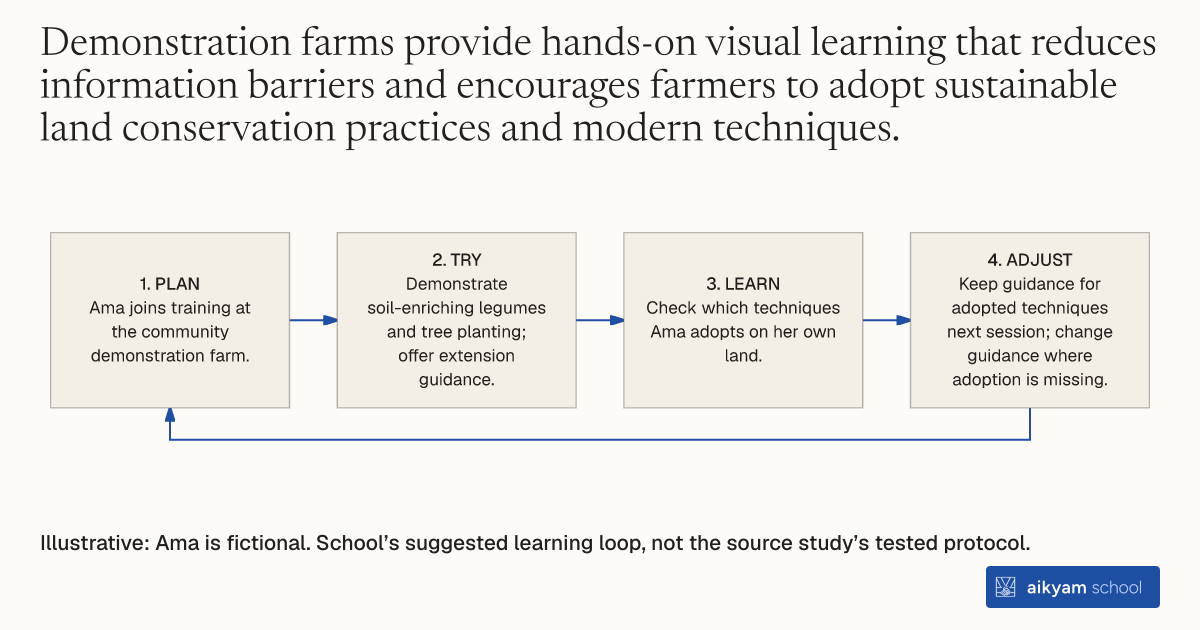
Try, learn and adjust
Check adoption after farm demonstrations
- Plan: Ama joins training at the community demonstration farm.
- Try: Demonstrate soil-enriching legumes and tree planting; offer extension guidance.
- Learn: Check which techniques Ama adopts on her own land.
- Adjust: Keep guidance for adopted techniques next session; change guidance where adoption is missing.
Illustrative: Ama is fictional. School’s suggested learning loop, not the source study’s tested protocol.
See source →School’s suggested learning loop: Observe farm improvements and adoption of conservation techniques; this loop does not establish food security effects.
How
When to use
Smallholder farmers in rural areas often lack access to modern agricultural techniques and soil conservation practices. Agricultural training and demonstration farming establishes a dedicated community demonstration farm at an epicenter to teach improved farming methods. The method serves rural farming households seeking to adopt conservation methods and enhance crop techniques.
Establish a demonstration farm at a community center to deliver practical agricultural extension training to local farmers.
- Allocate land at the epicenter community facility to establish a dedicated demonstration farm.
- Conduct agricultural training sessions and field demonstrations on modern farming techniques at the demonstration farm.
- Train local farmers in sustainable agricultural conservation practices, including planting soil-enriching legumes and planting trees.
- Encourage farmers to adopt specific farm improvements and updated agricultural techniques on their own cultivated land.
- Provide continuous agricultural extension guidance through trained local leaders and program facilitators.
Example
In Eastern Ghana, The Hunger Project established demonstration farms at epicenter community centers across 51 assigned village groupings, leading to significant increases in farm improvements and soil-enriching legume adoption among treated households.
About the study
Participants
2,744 households across 97 village groupings in 13 districts of Eastern Ghana.
Study Design
Randomized evaluation using public lotteries to assign 51 village groupings to treatment and 46 to control over a five-year period.
Results
Program mobilization increased the agricultural conservation subindex by 0.342 standard deviations, farm improvements made in the past year by 0.249, and soil-enriching legume planting by 6.1 percentage points, though overall food security index changes were statistically insignificant (0.086 standard deviations).