Try, learn and adjust
Check intensive guidance contact
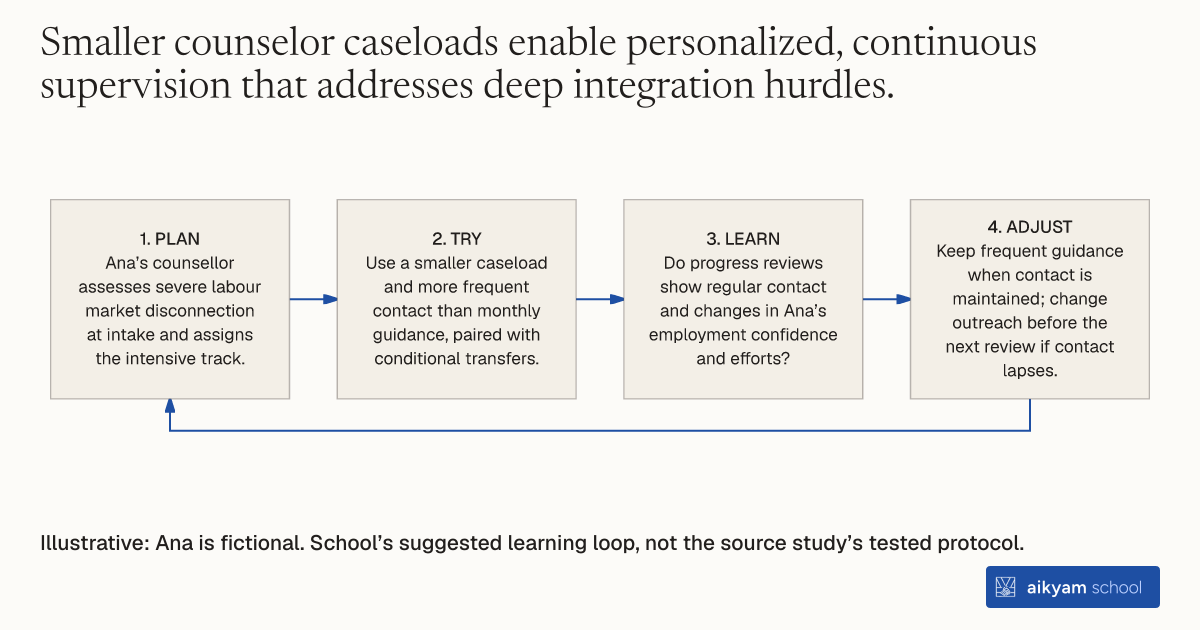
- Plan: Ana’s counsellor assesses severe labour market disconnection at intake and assigns the intensive track.
- Try: Use a smaller caseload and more frequent contact than monthly guidance, paired with conditional transfers.
- Learn: Do progress reviews show regular contact and changes in Ana’s employment confidence and efforts?
- Adjust: Keep frequent guidance when contact is maintained; change outreach before the next review if contact lapses.
Illustrative: Ana is fictional. School’s suggested learning loop, not the source study’s tested protocol.
See source →School’s suggested learning loop, not a tested source procedure. Observe contact, employment confidence and human capital efforts; the study did not randomly assign intensive-track status.
How
When to use
Many young jobseekers with severe integration problems and long-term inactivity fail to engage with standard career counseling programs. Standard monthly meetings provide insufficient monitoring and support for youth facing deep structural barriers to employment. This method tiers jobseekers into an intensive guidance track with smaller counselor caseloads and more frequent contact to boost human capital investment among the most disconnected youth.
Tier severely disconnected young jobseekers into an enhanced guidance track featuring lower counselor-to-client ratios and accelerated meeting schedules.
- Counselors assess incoming jobseekers during initial intake interviews to identify individuals experiencing severe labor market disconnection and long-term inactivity.
- Counselors assign high-need jobseekers (approximately 15% of total enrollees) to an intensive guidance track (Accompagnement Renforcé).
- Local centers reduce counselor caseloads on the intensive track to allow counselors to dedicate more time to each client.
- Counselors increase appointment frequency beyond the standard monthly baseline, conducting regular progress reviews, career planning sessions, and proactive outreach.
- Counselors pair frequent guidance sessions with conditional monthly transfers to reinforce program engagement and rebuild confidence in employment prospects.
Why it works
For severely disconnected youth who lack initial confidence, pairing frequent guidance with financial support generates substantial increases in self-assessed employment prospects and human capital efforts.
Example
In France, local Job Youth Centers placed approximately 15% of CIVIS enrollees with serious integration problems into an intensive guidance track (Accompagnement Renforcé); among severely disconnected youth, conditional cash transfers increased the human capital investment index by 14.30 points (p < 0.05) compared to control group peers.
About the study
Participants
Subgroup of 5,498 young jobseekers aged 18–22 across 82 French Job Youth Centers, where approximately 15% of total enrollees were assigned to intensive guidance tracks based on severe integration difficulties.
Study Design
Randomized controlled trial analyzing treatment effect heterogeneity across standard guidance versus intensive guidance track assignments.
Results
Severely disconnected jobseekers in the control group had a baseline human capital investment index score of -11.84, but conditional cash transfer treatment generated a statistically significant gain of +14.30 points (p < 0.05) on the index, driven by significant improvements in self-assessed employment prospects.