Research steps
Compare early and late reservation cohorts
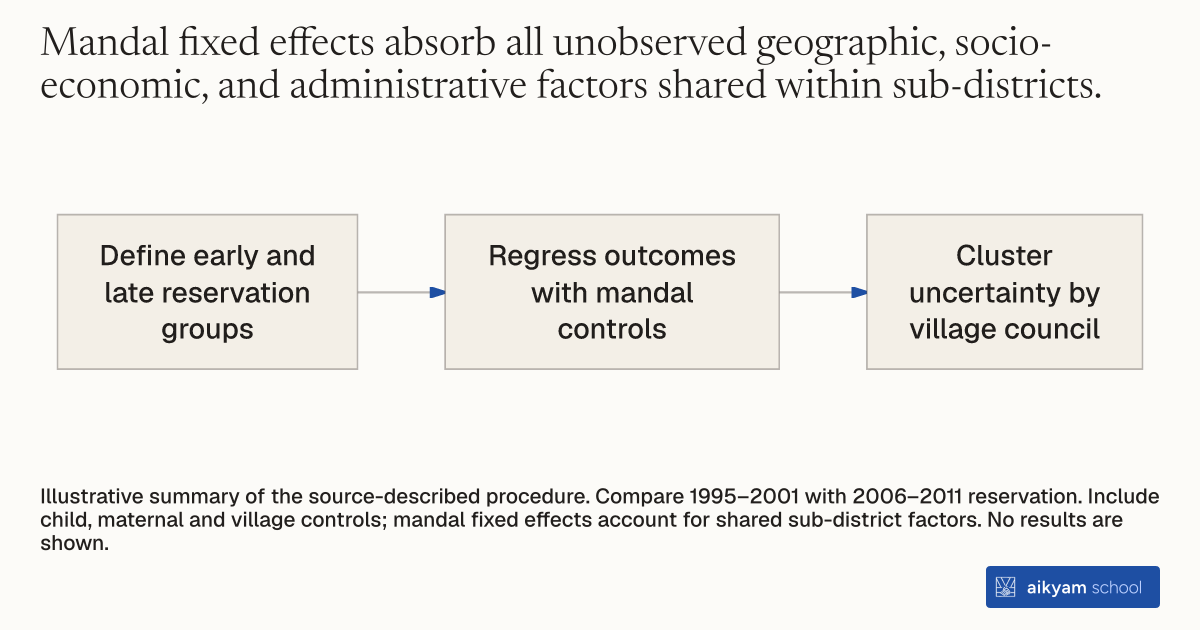
- Define early and late reservation groups
- Regress outcomes with mandal controls
- Cluster uncertainty by village council
Illustrative summary of the source-described procedure. Compare 1995–2001 with 2006–2011 reservation. Include child, maternal and village controls; mandal fixed effects account for shared sub-district factors. No results are shown.
See source →How
When to use
Evaluating policy impacts across decentralized jurisdictions requires controlling for administrative unobservables while avoiding political selection bias. Simple comparisons across regions produce biased estimates if local budget decisions or baseline geography differ across sub-districts. Intent-to-treat regression with sub-district fixed effects isolates causal policy gains across randomly assigned electoral cohorts.
Estimate an intent-to-treat linear regression comparing early and late policy cohorts while including administrative sub-district fixed effects.
- Define the primary binary treatment variable to equal 1 for jurisdictions assigned to early reservation and 0 for jurisdictions assigned to late reservation.
- Specify the regression equation linking individual child health and cognitive outcomes to the binary treatment indicator.
- Include mandal fixed effects in the regression specification to control for unobserved administrative and budget factors constant within each sub-district.
- Add child-level control variables including gender, monthly age dummies, first-born status, maternal age, maternal education, and maternal ethnicity.
- Control for village-level demographic imbalances, including the average number of adult women per household in the village.
- Cluster standard errors at the Gram Panchayat village council level to account for within-village error correlation.
Why it works
Combining fixed effects with random quota rotation ensures that estimated coefficient differences isolate the true causal effect of early policy exposure.
Example
Researchers evaluated test scores and growth for 502 eight-year-old children across 16 mandals in Andhra Pradesh in 2009 using intent-to-treat regressions. Controlling for mandal fixed effects and maternal characteristics revealed that early exposure to female reservation increased average composite test scores by 0.188 standard deviations and height-for-age z-scores by 0.258 standard deviations.
About the study
Participants
502 children aged 8 years in 2009 across 16 mandals in 6 rural districts of Andhra Pradesh, India, with an average of 4.3 Gram Panchayats per mandal.
Study Design
Intent-to-treat linear regression with mandal fixed effects, monthly age dummies, baseline maternal demographic controls, and standard errors clustered at the Gram Panchayat level.
Results
Early reservation exposure increased average test scores by 0.188 standard deviations (R-squared 0.29) and height-for-age z-scores by 0.258 standard deviations (R-squared 0.10), while reducing stunting by 6.4 percentage points.