Research steps
Follow children from infancy to school
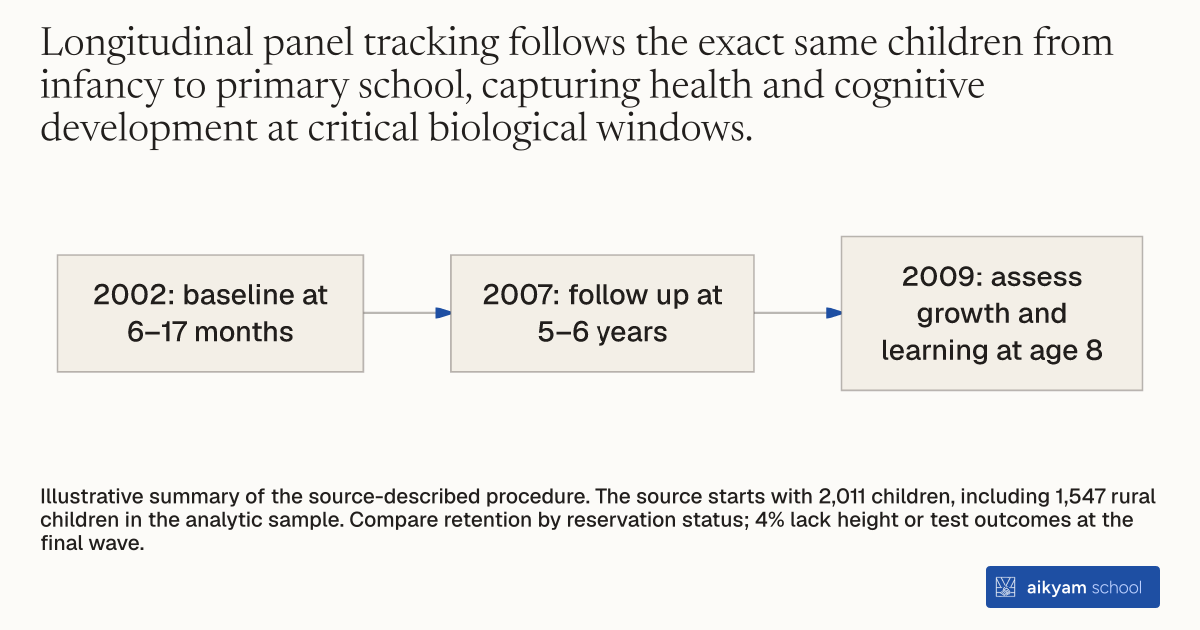
- 2002: baseline at 6–17 months
- 2007: follow up at 5–6 years
- 2009: assess growth and learning at age 8
Illustrative summary of the source-described procedure. The source starts with 2,011 children, including 1,547 rural children in the analytic sample. Compare retention by reservation status; 4% lack height or test outcomes at the final wave.
See source →How
When to use
Evaluations of early childhood policy interventions often fail to measure long-term effects because tracking young children across multiple development stages is difficult. Panel survey tracking measures health, growth, and cognitive progress at multiple early life intervals for a fixed cohort of children. This method helps researchers and evaluators assess how early life policy exposure impacts long-term human capital formation into primary school age.
Track a birth cohort of children through longitudinal panel survey rounds to measure nutritional and cognitive evolution over time.
- Sample a cohort of 2,011 young children aged 6 to 17 months across 20 mandals in 6 rural districts during the initial baseline round in fall 2002.
- Administer child, household, and community survey questionnaires to collect baseline household demographics, maternal characteristics, and village infrastructure data.
- Conduct a second panel tracking survey round between January and July 2007 when the sample cohort reaches 5 to 6 years of age.
- Conduct a third panel tracking survey round in the second half of 2009 when the sample cohort reaches approximately 8 years of age.
- Administer standardized cognitive, reading, math, and vocabulary assessments alongside height and weight measurements during the primary school age round.
- Verify and account for attrition across rounds by comparing child sample retention rates across treatment and control jurisdictions.
Why it works
This design isolates early life health gains from later schooling environment changes and rules out mortality or migration selection bias.
Example
In rural Andhra Pradesh, the Young Lives Survey tracked 1,547 rural children sampled at 6 to 17 months in 2002 across three survey rounds in 2002, 2007, and 2009. The panel survey achieved a 96% retention rate at age 8 in 2009, with only 4% missing test scores or height-for-age z-scores, enabling researchers to link early childhood health gains to later cognitive achievement.
About the study
Participants
2,011 children aged 6 to 17 months at baseline in 2002 across 20 mandals in 6 rural districts of Andhra Pradesh, India (1,547 rural children forming the analytic target sample).
Study Design
Three-wave longitudinal panel study (Round 1: Sept–Dec 2002; Round 2: Jan–July 2007; Round 3: late 2009) collecting child, household, and community level data with panel fixed effects and attrition balance checks.
Results
Attrition between Round 1 (2002) and Round 3 (2009) was 4% for height-for-age and test score outcomes, with attrition rates showing no statistically significant correlation with local political reservation status (P-value 0.43).