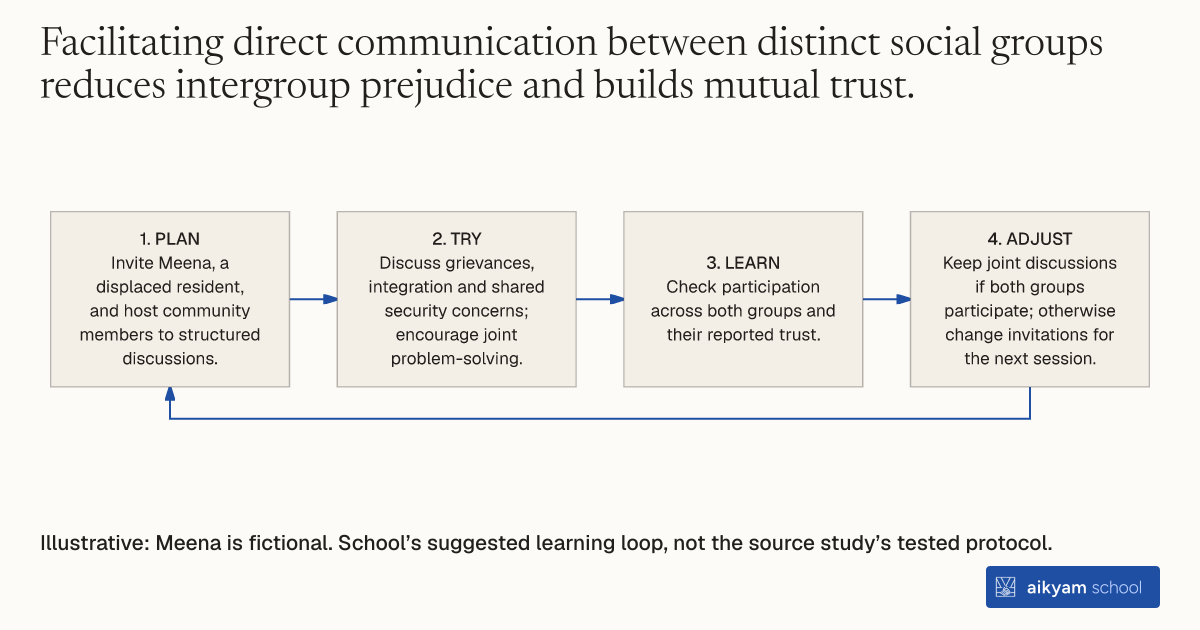
Try, learn and adjust
Check displaced and host residents join the dialogue
- Plan: Invite Meena, a displaced resident, and host community members to structured discussions.
- Try: Discuss grievances, integration and shared security concerns; encourage joint problem-solving.
- Learn: Check participation across both groups and their reported trust.
- Adjust: Keep joint discussions if both groups participate; otherwise change invitations for the next session.
Illustrative: Meena is fictional. School’s suggested learning loop, not the source study’s tested protocol.
See source →Participation, intergroup attitudes and trust; no assumed security outcome. School’s suggested learning loop, not a source-tested cycle.
How
When to use
Nonstate armed groups and insurgencies threaten community stability, elections, and civic cohesion in conflict-affected regions. Displaced persons and host communities experience intergroup tension and distrust that armed actors exploit. This method helps local organizations build social integration and reduce citizen support for violent nonstate actors.
Conduct intergroup community dialogues between displaced populations and host communities to strengthen social integration and shift support away from nonstate armed groups.
- Identify communities facing forced displacement and security threats from nonstate armed insurgencies.
- Convene structured dialogue sessions bringing together displaced individuals and host community members.
- Facilitate guided discussions addressing mutual grievances, social integration, and shared security concerns.
- Encourage joint community problem-solving and social cohesion activities across group lines.
- Monitor changes in intergroup attitudes, social trust, and citizen support for nonstate armed actors.
Why it works
This social integration shifts citizens' support away from violent nonstate armed groups.
Example
In Mozambique amid an Islamist insurgency, researchers evaluated intergroup community dialogues conducted with displaced populations and host communities, finding that dialogue interventions fostered social integration and shifted citizens' support away from nonstate armed groups.
About the study
Participants
Displaced individuals and host community members in Mozambique affected by an Islamist insurgency.
Study Design
Randomized field experiment evaluating intergroup community dialogues against control communities.
Results
Promoted social integration among displaced populations and host communities and shifted citizens' support away from nonstate armed groups.