In Simple Words
Think of a child watching how chores are split at home as reading a blueprint for how the world should work. When a mother starts earning income and domestic responsibilities shift, the child updates that blueprint to view gender roles as flexible and shared rather than fixed.
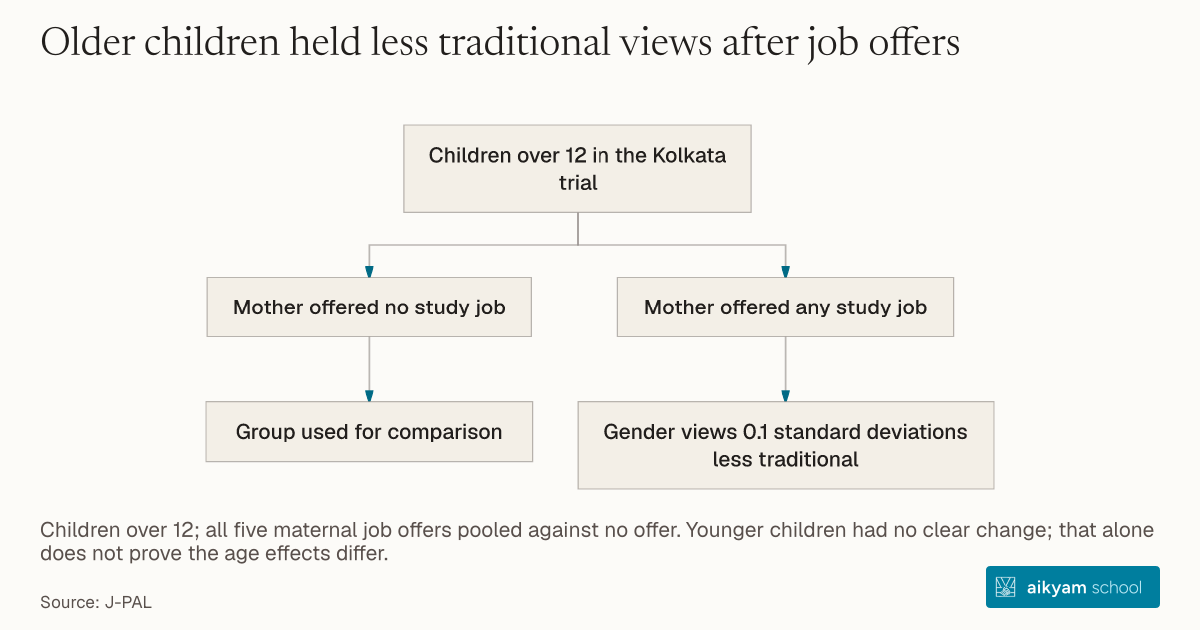
Children over 12 in the Kolkata trial
- Mother offered no study job
- Group used for comparison
- Mother offered any study job
- Gender views 0.1 standard deviations less traditional
Children over 12; all five maternal job offers pooled against no offer. Younger children had no clear change; that alone does not prove the age effects differ.
See source →Research question
Traditional gender norms are reinforced across generations when children observe rigid domestic divisions of labor at home. Without exposure to working female role models within the household, children perpetuate traditional gender role expectations into adulthood.
Participants
Children over 12 years old across 1,670 households in Kolkata, West Bengal, India.
Study Design
Longitudinal RCT assessing children's gender attitude indices 10 weeks after maternal job assignment.
Results
Children over 12 whose mothers were assigned any job became 0.1 standard deviations less traditional in their gender views, whereas attitudes of younger children showed no measurable change.
Takeaway
Evaluate the multi-generational impact of female economic empowerment programs by measuring attitudinal shifts in adolescent household dependents.
Source and citation
See source →Read alongside the research
Plain-English glossary
Original explanations, informed by the references below. Examples are illustrations, not data from the studies above. The research text stays unchanged.
- Longitudinal study
A study that checks the same group of people at different times. This lets researchers examine how things change over time.
ExampleResearchers ask the same workers about their wellbeing at the start, after three months and after six months.
NICE · Longitudinal study ↗Read more about longitudinal study →- Randomized controlled trial
A study that uses chance, like drawing lots, to decide who receives each option being compared. Researchers compare the groups’ outcomes to estimate the effect of those options.
ExampleA lottery assigns volunteers to a training programme or a comparison group. Researchers then compare their outcomes.
GET-IT glossary · Randomized study ↗Read more about randomized controlled trial →