Research procedure
Survey referrers during candidate testing
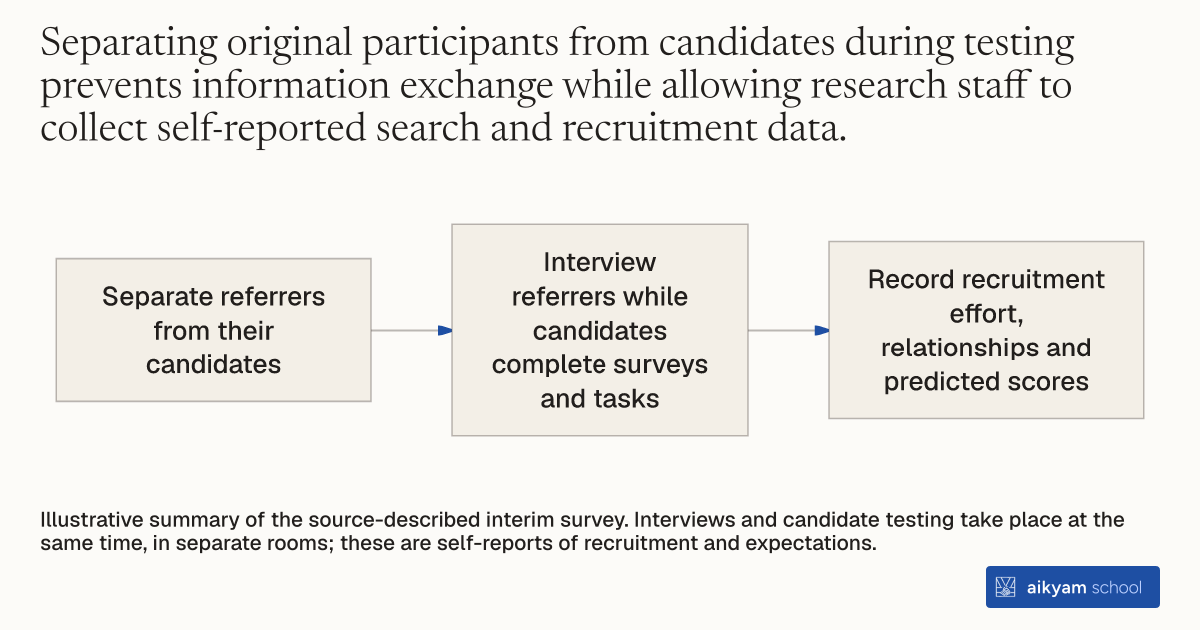
- Separate referrers from their candidates
- Interview referrers while candidates complete surveys and tasks
- Record recruitment effort, relationships and predicted scores
Illustrative summary of the source-described interim survey. Interviews and candidate testing take place at the same time, in separate rooms; these are self-reports of recruitment and expectations.
See source →How
When to use
Administer a structured interim questionnaire to original workers while their referred candidates complete job tasks. This captures qualitative recruitment search dynamics, candidate selection criteria, and effort expenditure without interfering with candidate testing. Use this method when evaluating peer recruitment mechanics in labor research.
Administer a brief structured interim questionnaire to original participants in a separate room while referred candidates undergo testing.
- Escort original participants to an isolated interview room upon returning to the site with their candidate.
- Conduct the interview while the referred candidate fills out intake surveys and completes assigned job tasks.
- Survey the participant on the recruitment process used to contact and select their referred candidate.
- Record details on search effort, candidate relationships, reasons for selection, and financial or social transfer expectations.
- Administer specific questions regarding the participant's direct prediction of the candidate's expected task performance score.
Why it works
Surveying participants simultaneously ensures high response rates and immediate recall of recruitment decisions.
Example
Field staff administered interim surveys to returning original participants in Kolkata, India, while 407 referred candidates completed testing. The interim survey captured participant expectations and selection mechanics across 561 cognitive treatment sessions.
About the study
Participants
407 returning original male participants out of 561 total in Kolkata, India.
Study Design
Individual structured interim survey administration conducted simultaneously with referral candidate task testing.
Results
Captured referral recruitment process data across 407 participating pairs, recording an average predicted candidate score of 3.5 correct puzzles.