Research procedure
Protect privacy in sensitive surveys
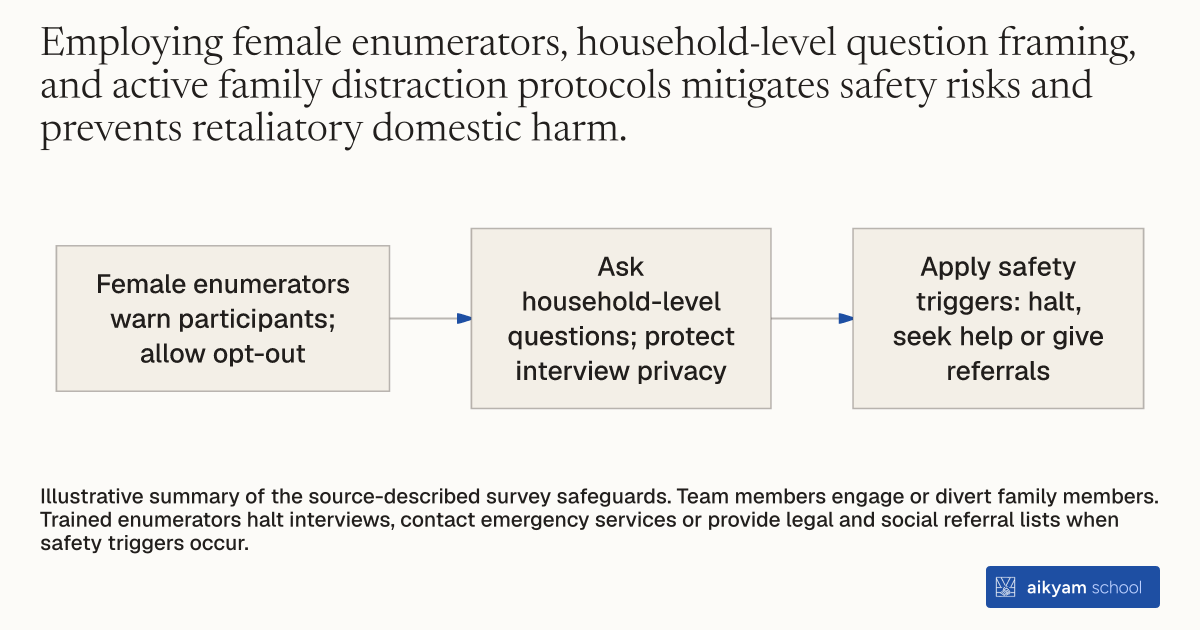
- Female enumerators warn participants; allow opt-out
- Ask household-level questions; protect interview privacy
- Apply safety triggers: halt, seek help or give referrals
Illustrative summary of the source-described survey safeguards. Team members engage or divert family members. Trained enumerators halt interviews, contact emergency services or provide legal and social referral lists when safety triggers occur.
See source →How
When to use
Surveying citizens on gender-based violence carries significant risks of re-traumatization and retaliatory harm. Standard household surveys often expose respondents to domestic scrutiny when family members oversee interviews. This method structures ethical data collection protocols to safely measure gender-based violence experiences and perceptions without endangering participants.
Execute ethical citizen survey protocols to gather gender-based violence data while protecting respondent safety and privacy.
- Research managers hire and deploy only female enumerators to conduct interviews with female citizens.
- Enumerators deliver advance warnings about sensitive content so participants can freely opt out before questioning begins.
- Survey designers frame questions around household-level events rather than asking respondents about personal abuse experiences.
- Survey team members engage or divert family members present during visits to maintain individual interview privacy.
- Trained enumerators halt interviews, contact emergency services, or provide legal and social referral lists when safety triggers occur.
Why it works
Advance warnings and referral provisions protect participant autonomy while ensuring immediate access to professional support services.
Example
J-PAL researchers fielded citizen surveys across 180 police station catchment areas in 12 districts of Madhya Pradesh, India, using female enumerators and household-level framing to safely measure security perceptions and crime experiences.
About the study
Participants
Citizens and station visitors across 180 police station catchment areas in 12 districts of Madhya Pradesh, India, serving average catchment populations of 130,000 citizens.
Study Design
Randomized controlled trial collecting endline survey data from police officers, station visitors, and catchment area citizens between February and October 2020.
Results
Ethical surveys revealed 10 percent female awareness of help desks, visitor comfort levels of 3.39 out of 4 in high-implementation stations, and no significant change in overall citizen perceptions of safety.