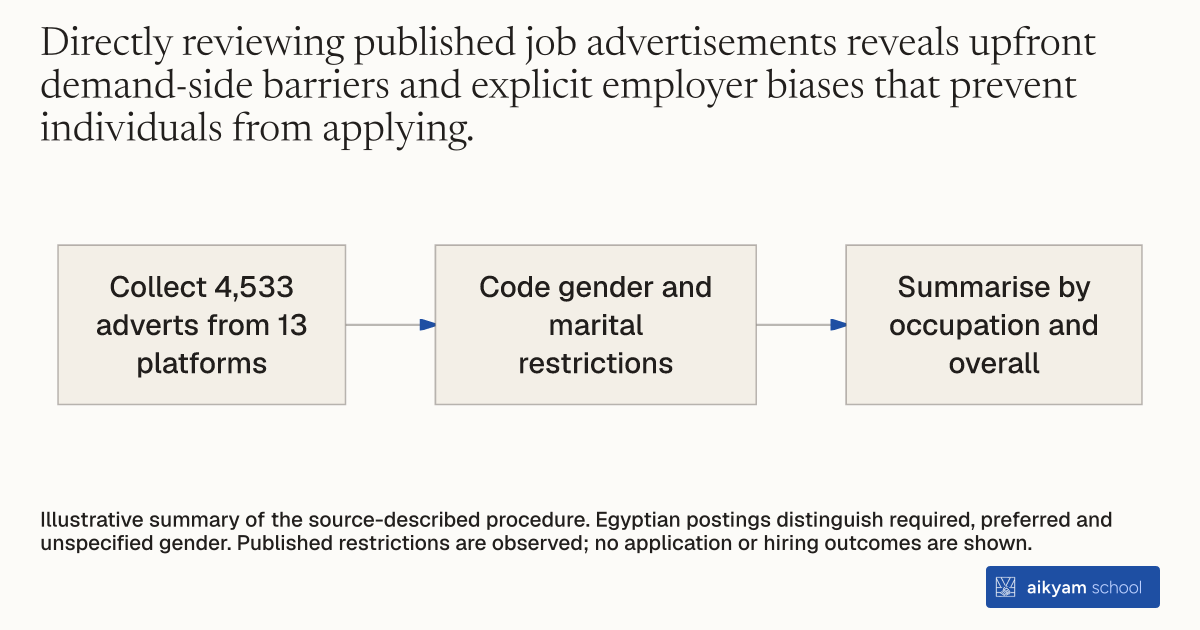
Research steps
Code restrictions in job adverts
- Collect 4,533 adverts from 13 platforms
- Code gender and marital restrictions
- Summarise by occupation and overall
Illustrative summary of the source-described procedure. Egyptian postings distinguish required, preferred and unspecified gender. Published restrictions are observed; no application or hiring outcomes are shown.
See source →How
When to use
In many developing labor markets, job advertisements frequently specify explicit demographic preferences or restrictions for applicants. Labor researchers and policymakers need to quantify how often employers directly restrict job opportunities by gender or marital status before applicants even submit resumes. This method measures explicit gender and marital status restrictions published across active online job listings.
Audit explicit demographic restrictions in job advertisements by systematically collecting and coding active online job listings across major employment platforms.
- Identify active online employment platforms operating in the target country, selecting 13 platforms in Egypt.
- Collect raw job posting data across all listed positions on these platforms, gathering a sample of 4,533 postings.
- Code each job posting for explicit gender specifications, categorizing entries as gender not specified, male required, male preferred, female required, or female preferred.
- Record any explicit marital status requirements published within the job text.
- Analyze gender requirements across specific occupational categories to identify gender-stereotyped roles.
- Calculate the overall percentage distribution of gender and marital status requirements across the collected sample.
Why it works
Analyzing posted requirements provides an objective benchmark of explicit labor market discrimination without relying on self-reported employer surveys.
Example
Researchers audited 4,533 online job postings across 13 platforms in Egypt and found that 14 percent of postings explicitly required men, 2 percent preferred men, 4 percent required women, less than 1 percent preferred women, and 79 percent specified no gender requirement.
About the study
Participants
4,533 online job postings collected across 13 job platforms listing employment opportunities in Egypt.
Study Design
Observational audit and content analysis of online job advertisements, coding each posting for explicit gender requirements (required, preferred, or not specified) and marital status rules.
Results
79 percent of postings did not specify gender, 14 percent required men, 2 percent preferred men, 4 percent required women, and less than 1 percent preferred women; only 5 postings (less than 1 percent) required a specific marital status, all specifying single.