In Simple Words
Imagine a music audition held behind a thick velvet curtain where judges can only hear the instrument playing without seeing the musician. Removing visual demographic identity prevents implicit prejudice from skewing performance scoring.
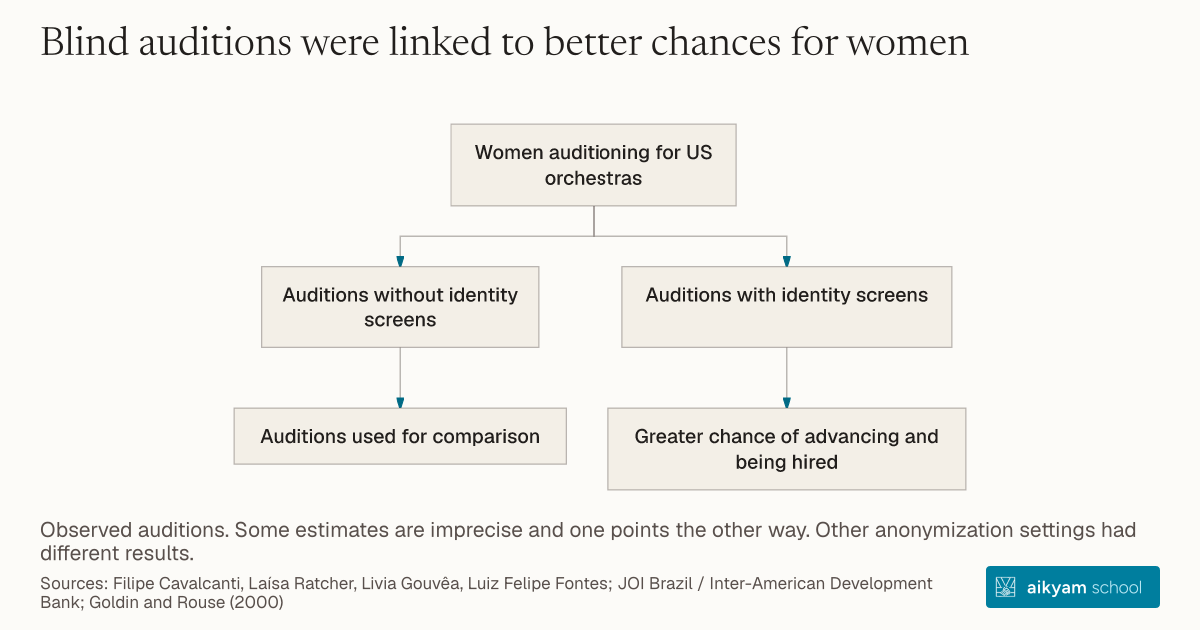
Women auditioning for US orchestras
- Auditions without identity screens
- Auditions used for comparison
- Auditions with identity screens
- Greater chance of advancing and being hired
An analysis of actual orchestra auditions links identity screens to greater chances of women advancing and being hired. Some estimates are imprecise and one points the other way. This is observed evidence, not a randomized comparison. Other anonymization settings can differ.
See source →Audition evidence — Goldin and Rouse (2000) ↗Research question
Underrepresented groups, including women and racial minorities, face systemic hiring discrimination when demographic indicators are visible on employment applications. However, unthoughtful anonymization policies can backfire depending on employer selection dynamics.
Participants
Symphony orchestra audition candidates in the United States, job applicants across major urban labor markets in France and the US.
Study Design
Field experiments and quasi-experimental audits comparing blind audition screens and anonymized resumes ("Ban the Box") against standard hiring practices.
Results
Blind auditions increased the probability that female musicians advanced from preliminary rounds and were hired by major orchestras. However, mandatory resume anonymization or hiding criminal history records generated mixed or negative unintended consequences in certain corporate screening contexts.
Takeaway
Implement audited blind screening protocols for initial candidate resume evaluation in public and private recruitment workflows.
Source and citation
See source →Evidence in Labor Market Policies and Implications for Brazil: Job Search Assistance
Copyright © 2023 Inter-American Development Bank.
Full source notice
Copyright © 2023 Inter-American Development Bank ("IDB"). This work is subject to a Creative Commons license CC BY 3.0 IGO (https://creativecommons.org/licenses/by/3.0/igo/legalcode). The terms and conditions indicated in the URL link must be met and the respective recognition must be granted to the IDB. Further to section 8 of the above license, any mediation relating to disputes arising under such license shall be conducted in accordance with the WIPO Mediation Rules. Any dispute related to the use of the works of the IDB that cannot be settled amicably shall be submitted to arbitration pursuant to the United Nations Commission on International Trade Law (UNCITRAL) rules. The use of the IDB's name for any purpose other than for attribution, and the use of IDB's logo shall be subject to a separate written license agreement between the IDB and the user and is not authorized as part of this license. Note that the URL link includes terms and conditions that are an integral part of this license.