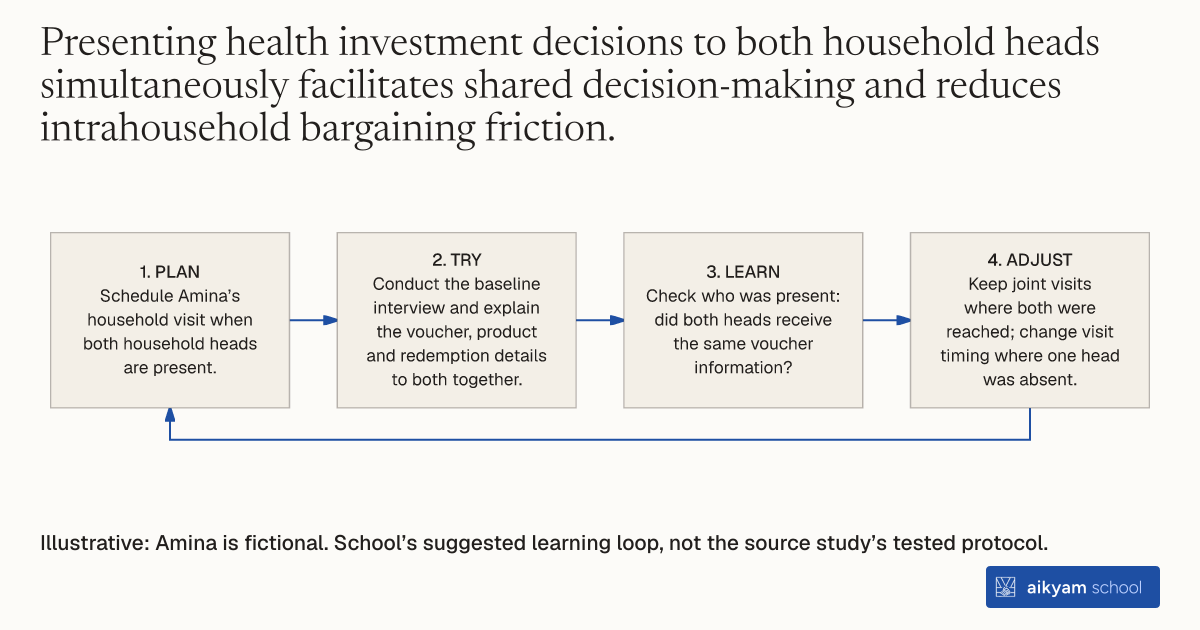
Try, learn and adjust
Check both household heads receive voucher details
- Plan: Schedule Amina’s household visit when both household heads are present.
- Try: Conduct the baseline interview and explain the voucher, product and redemption details to both together.
- Learn: Check who was present: did both heads receive the same voucher information?
- Adjust: Keep joint visits where both were reached; change visit timing where one head was absent.
Illustrative: Amina is fictional. School’s suggested learning loop, not the source study’s tested protocol.
See source →School’s suggested loop, not a tested source procedure. Observe joint presence and voucher delivery; do not assume a household-level purchase gain.
How
When to use
Intrahousehold resource allocation dynamics can cause differences in preventive health investments depending on which partner controls spending. Reaching only one spouse may limit health product uptake if household purchasing choices require mutual agreement. This method targets both adult decision-makers together when offering subsidized health product vouchers to rural families.
Deliver health product discount vouchers to both male and female household heads together during joint home visits rather than approaching one spouse individually.
- Identify dual-headed households from local community lists or primary school registers.
- Schedule home visits for times when both the male and female household heads are present.
- Conduct the baseline survey interview with both household heads present.
- Present the price-discounted bednet voucher to both spouses simultaneously.
- Explain the voucher redemption details and product features to both decision-makers jointly.
Why it works
Approaching both spouses together ensures that cash management and health choices are aligned immediately during the visit.
Example
In Western Kenya, field staff delivered bednet discount vouchers directly to both male and female heads of household jointly across one-third of 1,289 sampled rural households in eight market areas.
About the study
Participants
1,289 dual-headed rural households across eight markets in Western Kenya, averaging 7.43 members per household and \$397 in assets.
Study Design
Randomized controlled trial comparing voucher delivery to both heads jointly against targeting either the female head alone or the male head alone, evaluated across 22 discount price levels from 0 to 300 Ksh (\$0 to \$4.60).
Results
Presenting the voucher to both household heads jointly increased bednet take-up by about 7 percentage points compared to targeting either spouse alone. However, an equivalent 7 percentage point increase in take-up could also be achieved by an 18 percent (\$0.27) price reduction.