Try, learn and adjust
Check delivery of the financial message
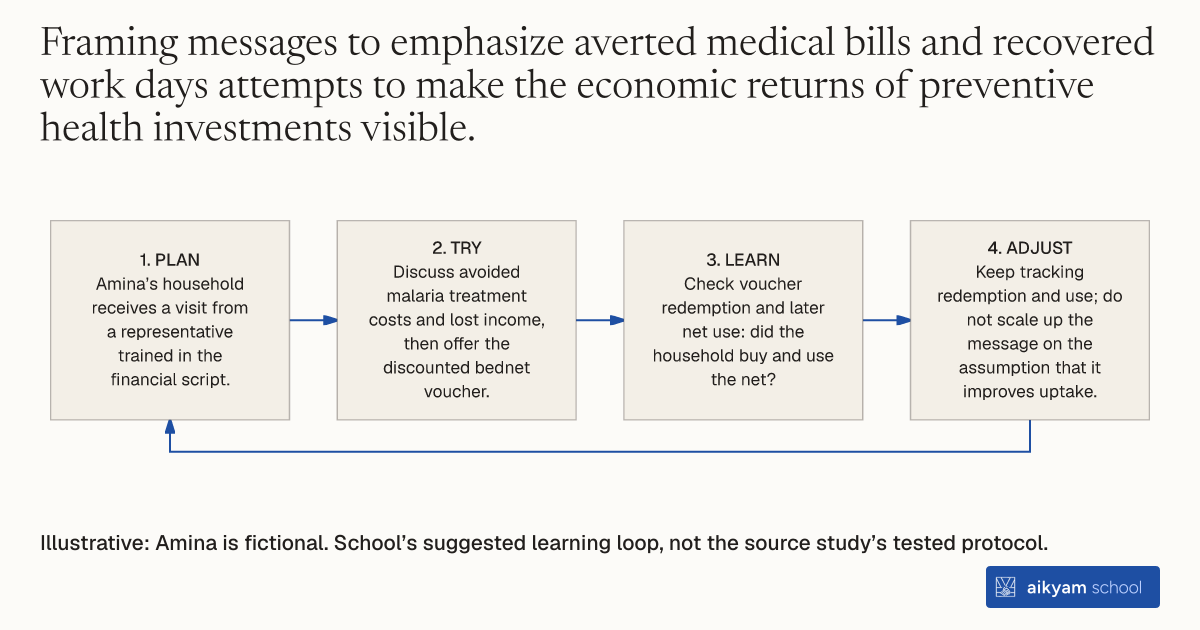
- Plan: Amina’s household receives a visit from a representative trained in the financial script.
- Try: Discuss avoided malaria treatment costs and lost income, then offer the discounted bednet voucher.
- Learn: Check voucher redemption and later net use: did the household buy and use the net?
- Adjust: Keep tracking redemption and use; do not scale up the message on the assumption that it improves uptake.
Illustrative: Amina is fictional. School’s suggested learning loop, not the source study’s tested protocol.
See source →School’s suggested loop, not a tested source procedure. Observe purchase and use. The source found no statistically or economically significant message effect.
How
When to use
Rural households facing endemic malaria often underinvest in preventive health technologies like long-lasting bednets. Program managers use financial marketing messages to highlight monetary savings from avoided illness rather than focusing only on health facts. This method targets cash-constrained families deciding whether to purchase protective health devices.
Promote preventive health investments by delivering a verbal marketing message that prompts household decision-makers to focus on the financial savings from averted medical costs and avoided lost working time.
- Train enumerators or sales representatives to deliver a standardized financial framing script during home visits.
- Visit selected household heads at home to present the financial message alongside a product discount voucher.
- Ask household decision-makers to consider the money spent on clinical treatment when family members contract malaria.
- Highlight the daily wages and agricultural productivity lost when adults fall sick with malaria and miss work.
- Offer the household a price-discounted bednet voucher immediately following the verbal financial message.
Why it works
Highlighting monetary gains aims to encourage adoption without altering product prices.
Example
Field staff in Western Kenya delivered a financial framing message emphasizing saved medical costs and recovered income to rural households when distributing bednet discount vouchers for redemption at local retail shops.
About the study
Participants
1,289 households across eight rural market areas in Western Kenya, with an average household size of 7.43 members and \$397 in assets.
Study Design
Randomized controlled trial comparing financial framing, health framing, and a no-message control group across 22 discount price levels ranging from 0 to 300 Ksh (\$0 to \$4.60).
Results
Financial framing had no statistically or economically significant effect on bednet take-up compared to no message (coefficient 0.006, standard error 0.029) or on net usage at follow-up (coefficient 0.003, standard error 0.064).