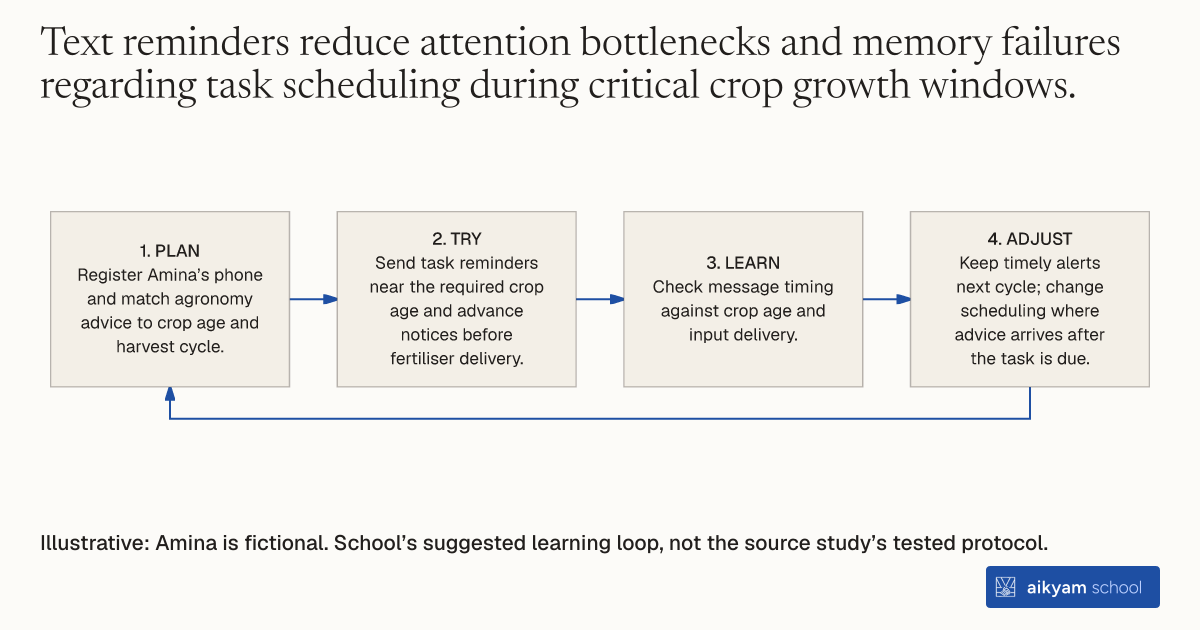
Try, learn and adjust
Check crop advice arrives at the right time
- Plan: Register Amina’s phone and match agronomy advice to crop age and harvest cycle.
- Try: Send task reminders near the required crop age and advance notices before fertiliser delivery.
- Learn: Check message timing against crop age and input delivery.
- Adjust: Keep timely alerts next cycle; change scheduling where advice arrives after the task is due.
Illustrative: Amina is fictional. School’s suggested learning loop, not the source study’s tested protocol.
See source →School’s suggested learning loop; not a tested source procedure. Observe task reminders and delivery notices. This timing check does not establish yield gains.
How
When to use
Smallholder farmers often face low crop yields due to delayed agricultural tasks and limited access to extension agents. This method delivers timely agronomic instructions directly to farmers to optimize farm task scheduling. It serves outgrower sugarcane farmers operating small plots within contract farming schemes.
Deliver personalized agricultural advice to smallholders using text messages timed to crop age and field operations.
- The agronomy department compiles a structured list of actionable agricultural advice messages based on crop age and harvest cycle.
- Field staff collect phone numbers and register enrolled farmers into an automated messaging platform during recruitment meetings or preceding harvest times.
- The messaging system sends personalized text alerts to registered farmers informing them to perform specific tasks, such as weeding or trashlining, right around the required crop age.
- The system sends advance notice texts before input deliveries, instructing farmers to prepare their fields to receive and apply fertilizer on time.
Why it works
They also lower information acquisition costs for smallholders who lack frequent contact with agricultural extension agents.
Example
Mumias Sugar Company in Western Kenya enrolled 2,327 sugarcane plots in an SMS advisory program between 2011 and 2013. Registered farmers received tailored text alerts prompting specific tasks like weeding 12 weeks after planting and fertilizer application notifications. Program participation increased plot yields by 3.33 tons per hectare, raising company profits by \$43 and net farmer earnings by \$54 per plot at a messaging cost of \$0.30 per farmer.
About the study
Participants
2,327 smallholder sugarcane plots across 354 fields in Western Kenya, with plot sizes mostly below one hectare.
Study Design
Field-level Randomized Controlled Trial across two rounds (2011–2013 and 2012–2014) with randomization stratified by harvest cycle, geographic zone, and baseline yields, evaluated using objective sugar factory weighbridge administrative data.
Results
In Round 1, access to the SMS program raised sugarcane yields by 3.33 tons per hectare (p < 0.05), representing an 8% increase over the control group average of 41.63 tons per hectare and an 11.5% treatment-on-treated effect for compliers.