Research procedure
Describe detention-based therapy delivery
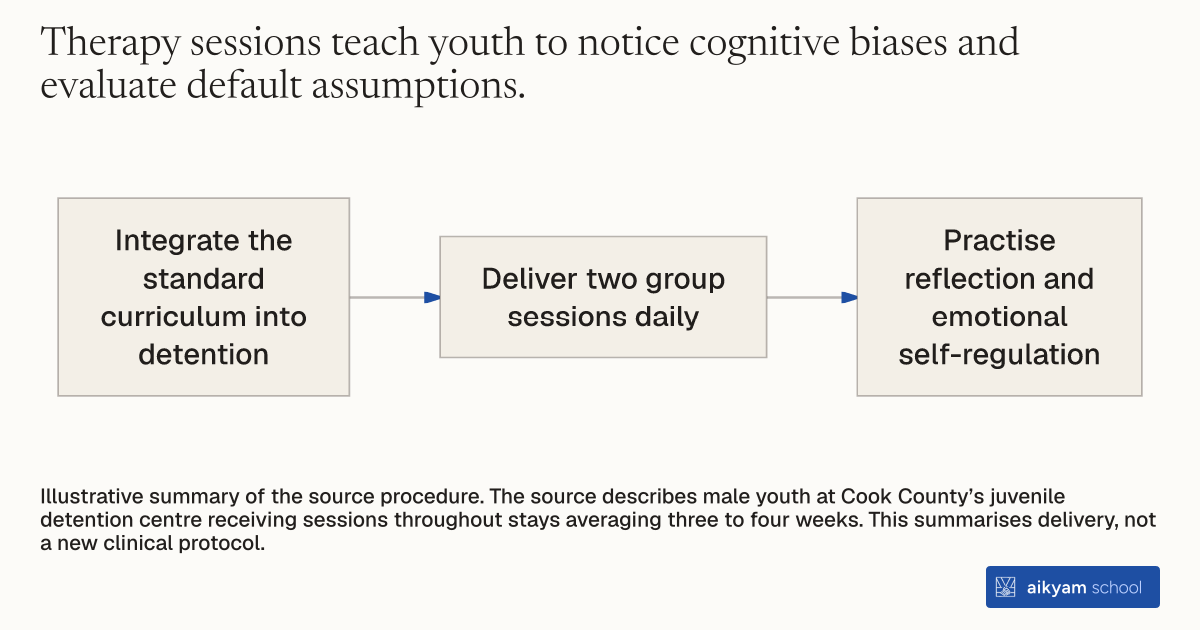
- Integrate the standard curriculum into detention
- Deliver two group sessions daily
- Practise reflection and emotional self-regulation
Illustrative summary of the source procedure. The source describes male youth at Cook County’s juvenile detention centre receiving sessions throughout stays averaging three to four weeks. This summarises delivery, not a new clinical protocol.
See source →How
When to use
Youth in juvenile detention facilities face high rates of re-arrest and readmission after release. Temporary detention provides a structured opportunity to address automatic thinking and cognitive biases. Deliver twice-daily behavioral therapy sessions to incarcerated youth to lower post-release recidivism.
Deliver twice-daily cognitive behavioral therapy sessions to male youth in juvenile detention facilities over three to four weeks.
- Detention facility staff deliver a standardized CBT curriculum integrated into existing center infrastructure.
- Staff conduct two group therapy sessions each day with detained male youth.
- Facilitators guide youth through exercises that identify cognitive biases and distorted decision-making.
- Facilitators teach participants techniques to slow decision-making and improve emotional self-regulation.
- Facility staff sustain sessions throughout each participant's stay, averaging three to four weeks per youth at US\$60 per participant.
Why it works
This allows participants to slow down decision-making and regulate emotions during conflicts after release.
Example
Staff at the Cook County Juvenile Temporary Detention Center in Chicago delivered twice-daily CBT sessions over three to four weeks to male youth averaging eight previous arrests. The US\$60 program reduced readmission rates by 39 percent within two months and 21 percent after 18 months, costing US\$114 per readmission avoided.
About the study
Participants
Male youth in the Cook County Juvenile Temporary Detention Center in Chicago who averaged eight prior arrests.
Study Design
Randomized controlled trial comparing twice-daily staff-led CBT sessions over three to four weeks against standard detention procedures.
Results
CBT reduced readmissions by 39 percent within 2 months of release and 21 percent 18 months later, saving US\$114 per readmission avoided per year.