Research design
Describe therapy with cash support
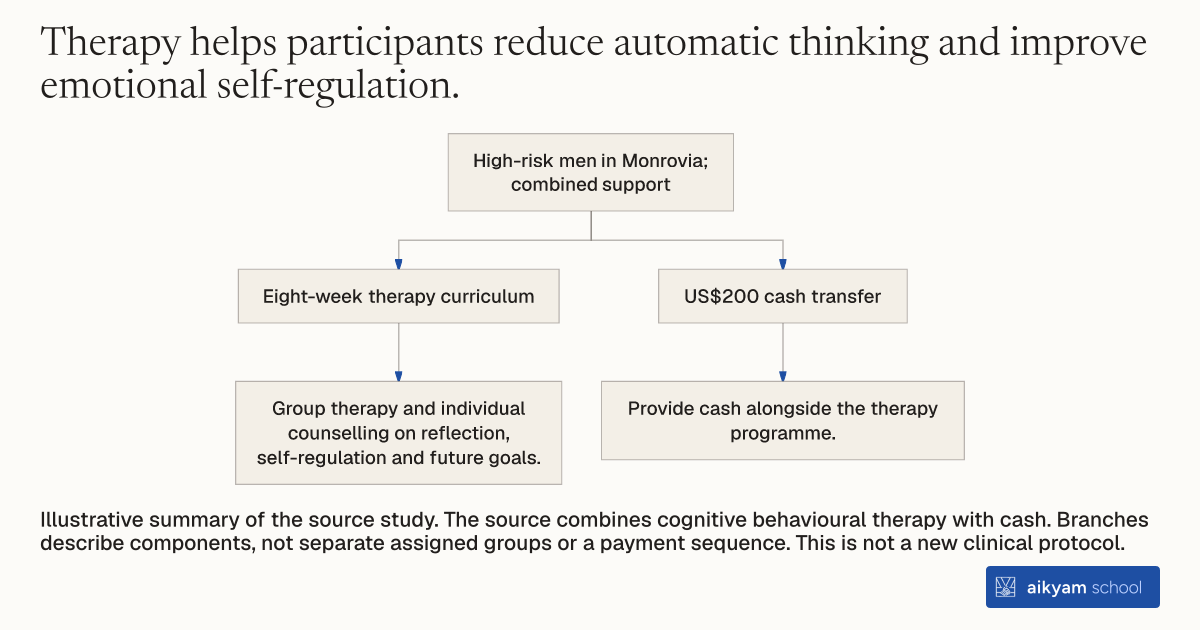
High-risk men in Monrovia; combined support
- Eight-week therapy curriculum
- Group therapy and individual counselling on reflection, self-regulation and future goals.
- US$200 cash transfer
- Provide cash alongside the therapy programme.
Illustrative summary of the source study. The source combines cognitive behavioural therapy with cash. Branches describe components, not separate assigned groups or a payment sequence. This is not a new clinical protocol.
See source →How
When to use
High-crime neighborhoods contain young men engaging in criminal and violent behaviors. These individuals face distorted decision-making caused by cognitive biases and default assumptions. Deliver a combined therapy and cash intervention for high-risk men to lower violent activity.
Combine cognitive behavioral therapy group sessions, individual counseling, and cash transfers to reduce participant crime.
- Facilitators deliver an eight-week curriculum combining group therapy and one-on-one counseling in high-crime neighborhoods.
- Facilitators teach participants to recognize cognitive biases, slow down decision-making, and improve self-regulation.
- Facilitators guide participants to adopt non-violent identities and plan for future goals.
- Program staff distribute a US\$200 cash transfer to participants alongside the therapy program.
Why it works
Cash transfers provide immediate financial support so participants do not rely on crime to survive.
Example
Implementers in high-crime neighborhoods in Monrovia, Liberia delivered an eight-week CBT curriculum with a US\$200 cash transfer to high-risk men. Over ten years, participants committed 200 fewer crimes compared to men in the comparison group.
About the study
Participants
High-risk men in high-crime neighborhoods in Monrovia, Liberia.
Study Design
Randomized controlled trial evaluating an eight-week CBT therapy program combined with a US\$200 cash grant against a control group.
Results
Therapy and cash decreased antisocial behaviors by 0.25 standard deviations over ten years, resulting in 200 fewer crimes committed per participant.