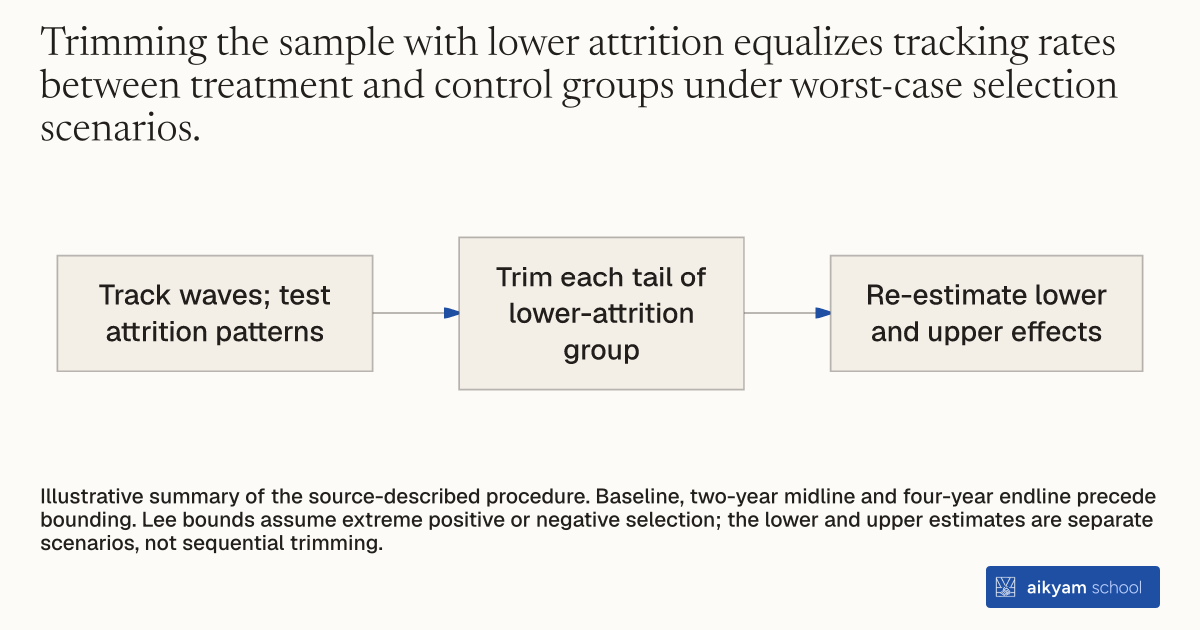
Research steps
Bound effects under selective attrition
- Track waves; test attrition patterns
- Trim each tail of lower-attrition group
- Re-estimate lower and upper effects
Illustrative summary of the source-described procedure. Baseline, two-year midline and four-year endline precede bounding. Lee bounds assume extreme positive or negative selection; the lower and upper estimates are separate scenarios, not sequential trimming.
See source →How
When to use
High geographic mobility among adolescent girls leads to panel attrition in multi-year randomized evaluations. Unchecked panel dropouts can introduce selective sample bias and threaten the internal validity of program estimates. Calculate sharp bounds under extreme selection assumptions to confirm whether estimated treatment effects remain robust to attrition.
Calculate Lee bounds on treatment effect estimates to evaluate program impacts under potential selective sample attrition.
- Surveyors track sampled participants across baseline, two-year midline, and four-year endline survey waves.
- Econometricians test whether treatment status or baseline participant characteristics predict survey attrition.
- Analysts identify the survey group with lower overall attrition across tracking waves.
- Researchers trim observations from above and below in the lower-attrition group to equalize sample proportions.
- Econometricians re-estimate unconditional program impacts on trimmed samples to generate sharp lower and upper bounds.
- Analysts verify that lower and upper bounds remain statistically significant and bounded away from zero.
Why it works
Demonstrating that lower and upper bounds remain statistically significant proves that estimated impacts are not artifacts of selective panel dropouts.
Example
Researchers evaluated the ELA program across 150 communities in Uganda, tracking 4,888 girls at midline (82% tracking rate) and 3,522 girls at endline (59% tracking rate). Despite 41% attrition by four-year endline, Lee bounds confirmed positive impacts on self-employment (lower bound 3.0 percentage points, upper bound 5.4 percentage points) and the economic empowerment index (lower bound 0.096, upper bound 0.185).
About the study
Participants
4,888 adolescent girls tracked at midline and 3,522 at endline across 150 communities in Kampala, Mukono, Iganga, and Jinja, Uganda, with average baseline age of 16.3 years.
Study Design
Cluster randomized control trial across 150 communities (100 treatment, 50 control) stratified by 10 branch offices, evaluating outcomes at baseline, midline (2 years), and endline (4 years) using OLS ANCOVA and Lee trimming bounds.
Results
Endline Lee bounds for self-employment ranged from a lower bound of 0.030 to an upper bound of 0.054; economic empowerment index Lee bounds ranged from 0.096 to 0.185; control over the body index Lee bounds ranged from 0.193 to 0.305.