Research steps
Aggregate local development spending
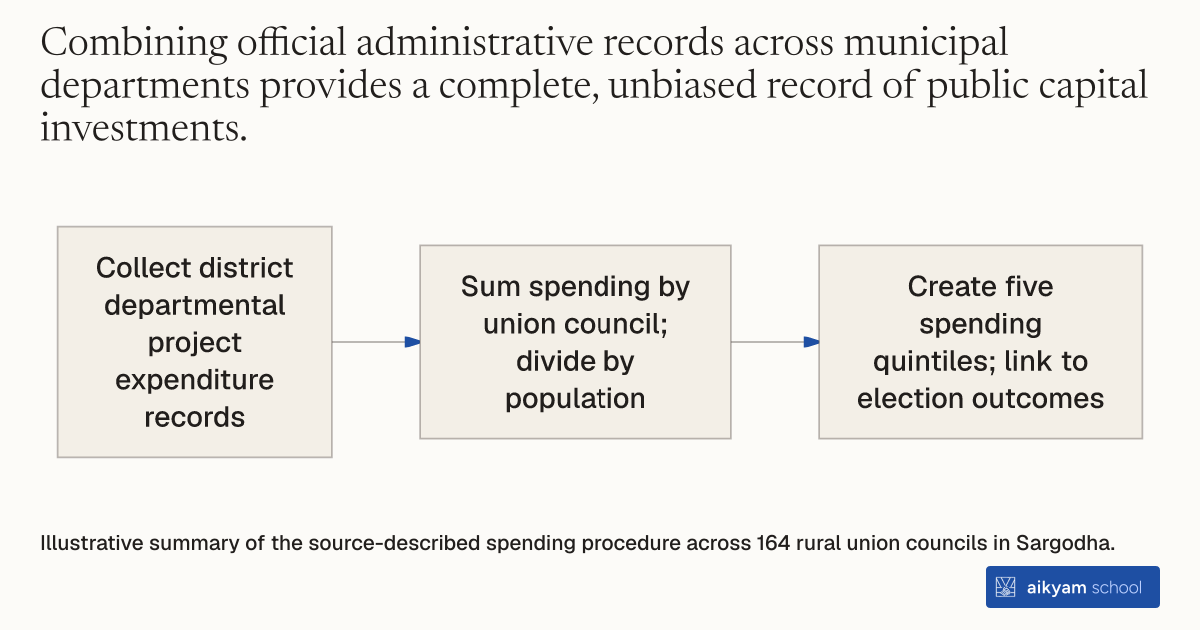
- Collect district departmental project expenditure records
- Sum spending by union council; divide by population
- Create five spending quintiles; link to election outcomes
Illustrative summary of the source-described spending procedure across 164 rural union councils in Sargodha.
See source →How
When to use
Researchers need to measure historical government investment at a local administrative level to evaluate whether public development spending influences voter choices. Aggregating administrative project records from local departments provides an objective measure of local public goods provision. This method creates localized per-capita spending metrics across union councils when municipal records are fragmented.
Aggregate public development spending at the union council level using administrative project records from district government departments.
- Collect administrative expenditure records from 2011 to 2015 from the Water-Sanitation, Building, and Health Departments of District Sargodha.
- Sum government spending within each union council across water filtration plants, water pipes, sanitation, drainage, and construction projects for schools, graveyards, and health facilities.
- Divide total government expenditure in each union council by its population to calculate spending per capita.
- Classify union councils into five spending quintiles based on spending per capita.
- Merge per-capita spending data with candidate electoral outcomes to test whether provincial development spending impacts ruling party vote shares.
Why it works
Standardizing spending per capita allows fair comparisons across union councils of varying population sizes.
Example
Researchers aggregated development spending across 164 rural union councils in Sargodha district from 2010 to 2015, finding an average per-capita expenditure of Rs. 2,001 across all councils, ranging from Rs. 0 in three councils to Rs. 16,512 in the highest-funded council.
About the study
Participants
Administrative expenditure records across 164 rural union councils in Sargodha district, Punjab province, Pakistan.
Study Design
Observational aggregation of departmental budget data from 2010 to 2015 into per-capita spending quintiles matched with candidate election returns.
Results
Ruling party development spending had no statistically significant correlation with ruling party candidates fielding probability, vote share, winning probability, or election rank across spending quintiles.