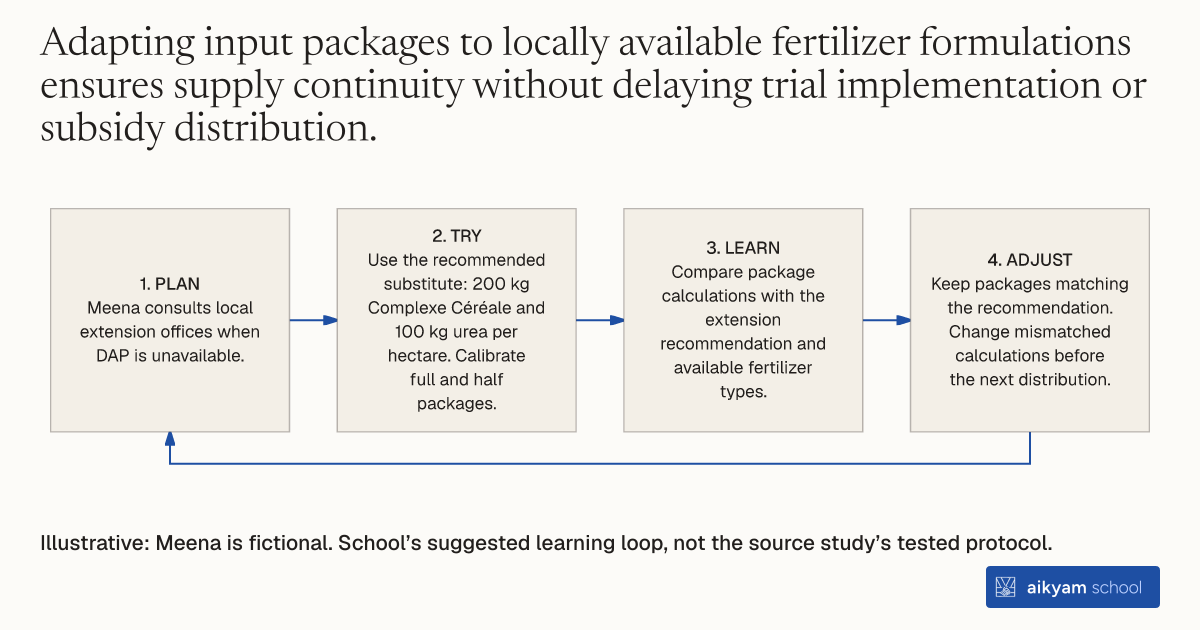
Try, learn and adjust
Check an available fertilizer substitute
- Plan: Meena consults local extension offices when DAP is unavailable.
- Try: Use the recommended substitute: 200 kg Complexe Céréale and 100 kg urea per hectare. Calibrate full and half packages.
- Learn: Compare package calculations with the extension recommendation and available fertilizer types.
- Adjust: Keep packages matching the recommendation. Change mismatched calculations before the next distribution.
Illustrative: Meena is fictional. School’s suggested learning loop, not the source study’s tested protocol.
See source →School’s suggested learning loop checks availability and package calculations, separately from the trial’s fertilizer substitution.
How
When to use
Use this method when targeted agricultural inputs are unavailable in local markets due to supply chain shortages. It solves the problem of program disruption by substituting alternative, locally available fertilizer formulations with equivalent nutritional values. It is designed for agricultural extension agents and project officers managing rural input distribution.
Substitute unavailable recommended fertilizer inputs with locally available chemical compositions that preserve target nutrient ratios.
- Consult local agricultural extension offices and research institutes to identify locally available fertilizer formulations.
- Review standard extension recommendations for per-hectare input requirements.
- Calculate the alternative blend needed to match target nutrient levels using available fertilizer types.
- Replace missing input types with a combination of cereal complex (Complexe Céréale NPK) and urea.
- Calibrate full and half per-hectare grant packages based on the alternative available formulation.
Why it works
Using extension-backed alternative blends maintains recommended soil nutrient ratios even during regional supply shortages.
Example
In southern Mali, when diammonium phosphate (DAP) was unavailable, research teams consulted local extension offices and substituted a blend of 200 kg Complexe Céréale and 100 kg urea per hectare for the original recommended 100 kg DAP and 150 kg urea formulation.
About the study
Participants
383 female rice farmers across 23 villages in Bougouni district, southern Mali.
Study Design
Randomized controlled trial providing full (308.20 kg/ha mean) or half (156.20 kg/ha mean) substitute fertilizer blends of Complexe Céréale and urea.
Results
Distributing the substitute blend of 200 kg Complexe Céréale and 100 kg urea per hectare achieved a 64 percentage point increase in fertilizer usage likelihood (p < 0.01) and raised rice output value by 31 percent in the full treatment group (p < 0.01).