Try, learn and adjust
Check solar ambassador outreach
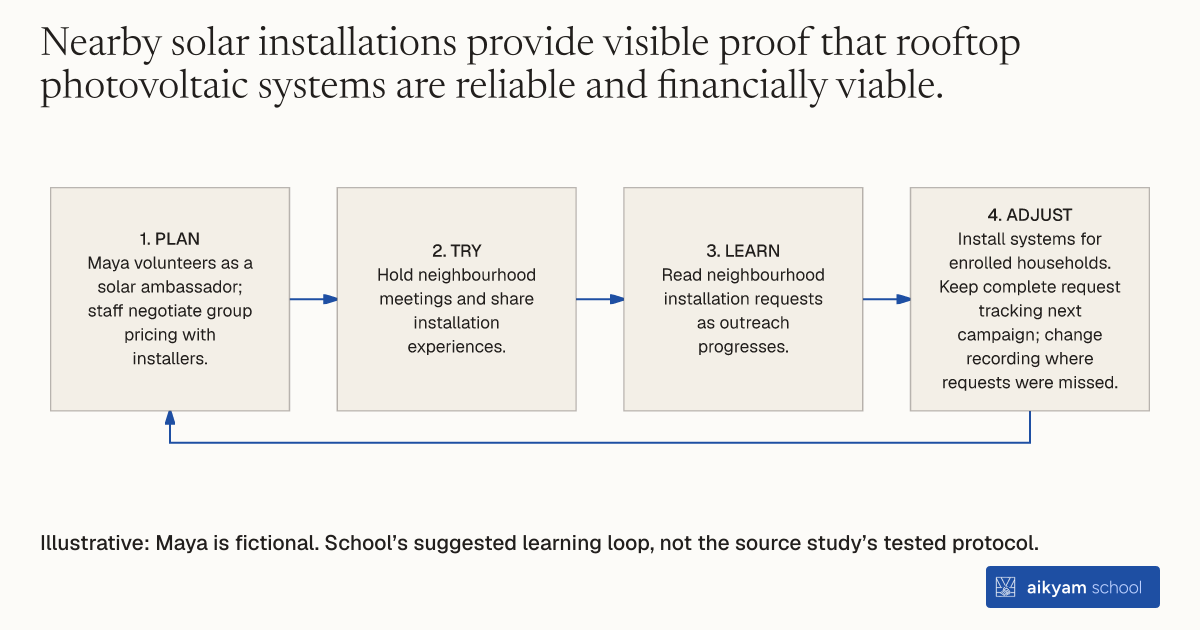
- Plan: Maya volunteers as a solar ambassador; staff negotiate group pricing with installers.
- Try: Hold neighbourhood meetings and share installation experiences.
- Learn: Read neighbourhood installation requests as outreach progresses.
- Adjust: Install systems for enrolled households. Keep complete request tracking next campaign; change recording where requests were missed.
Illustrative: Maya is fictional. School’s suggested learning loop, not the source study’s tested protocol.
See source →School’s suggested, untested learning loop. Observe installation requests and completed systems; this loop does not establish peer effects.
How
When to use
High upfront capital requirements and consumer information barriers impede residential rooftop solar adoption. Non-targeted marketing campaigns fail to overcome household hesitation. Deploying community solar ambassador programs helps local governments drive rooftop solar adoption through peer learning.
Deploy volunteer community ambassadors and group pricing schemes to accelerate neighborhood rooftop solar adoption.
- Municipal program managers select active local community volunteers to serve as solar ambassadors.
- Program staff partner with solar installers to negotiate tiered group pricing discounts based on community enrollment targets.
- Volunteer ambassadors host local neighborhood meetings and peer-to-peer discussions to share personal installation experiences.
- Program officers track neighborhood solar installation requests as volunteer outreach progresses.
- Solar installers execute bulk photovoltaic system installations across enrolled target neighborhoods.
Why it works
Peer ambassadors reduce information costs and trust barriers by sharing direct experiences with neighbors.
Example
In Connecticut, the Solarize campaign deployed peer ambassadors and group purchasing discounts across participating municipalities. The program accelerated rooftop solar uptake through localized peer effects and word-of-mouth social learning.
About the study
Participants
Residential homeowners across municipalities in Connecticut, California, and Switzerland.
Study Design
1 randomized controlled trial (Gillingham & Bollinger, 2020) and 4 quasi-experimental spatial autoregressive models analyzing rooftop solar installation clustering.
Results
Nearby solar installations statistically significantly increased the probability of subsequent neighborhood installations, while peer ambassador campaigns and group discounts lowered acquisition costs through social learning.