Try, learn and adjust
Check financial solar outreach
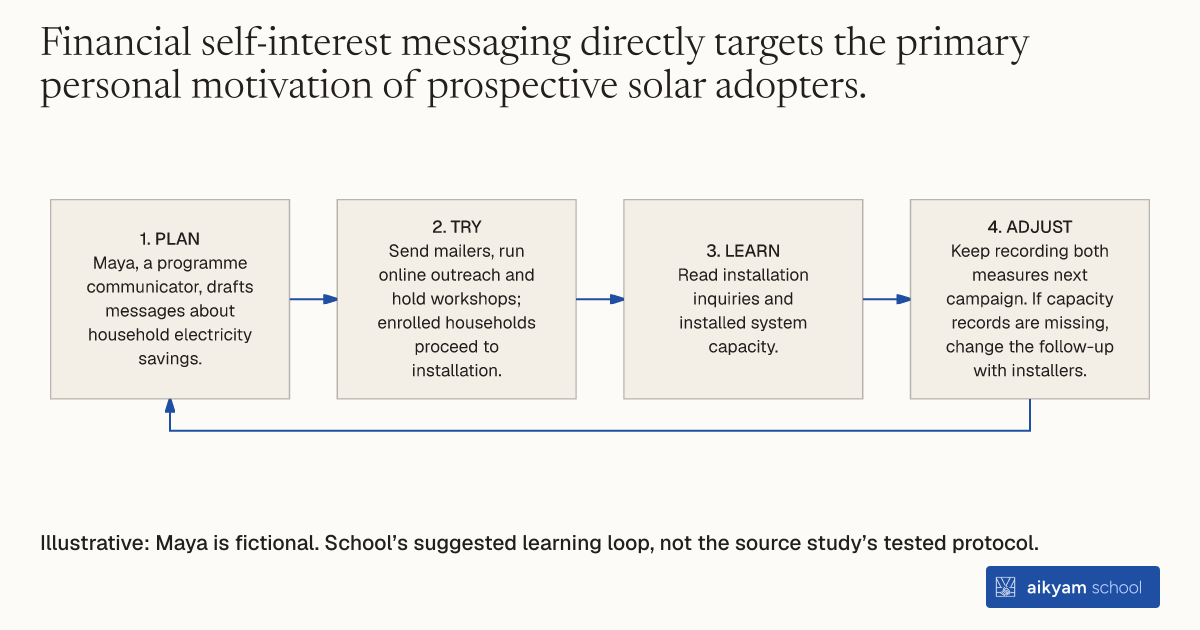
- Plan: Maya, a programme communicator, drafts messages about household electricity savings.
- Try: Send mailers, run online outreach and hold workshops; enrolled households proceed to installation.
- Learn: Read installation inquiries and installed system capacity.
- Adjust: Keep recording both measures next campaign. If capacity records are missing, change the follow-up with installers.
Illustrative: Maya is fictional. School’s suggested learning loop, not the source study’s tested protocol.
See source →School’s suggested, untested learning loop. Observe solar inquiries and system capacity; this loop does not establish why households adopt.
How
When to use
Prosocial framing that emphasizes community benefits often fails to motivate residential homeowners to install rooftop solar systems. Financial self-interest messaging highlights direct household monetary savings and return on investment. Municipal solar programs use this method to attract households with higher potential energy production.
Promote residential rooftop solar adoption using financial self-interest message framing instead of prosocial environmental appeals.
- Municipal clean energy directors develop promotional solar marketing materials for single-family homeowners.
- Program communicators craft message copy highlighting personal electricity bill reductions and household financial savings.
- Marketing teams distribute targeted self-interest communications through direct mailers, online campaigns, and community workshops.
- Program staff monitor solar installation inquiries and system capacities across targeted neighborhood cohorts.
- Participating solar installers fit photovoltaic systems for enrolled households to maximize electricity output.
Why it works
Households responding to cost-savings framing tend to have suitable roof orientations, leading to larger and more productive solar installations.
Example
A field experiment tested different promotional framing strategies for encouraging residential rooftop solar adoption. Self-interest messaging outperformed prosocial framing in generating solar installations, and adopting households installed higher-capacity systems.
About the study
Participants
Single-family homeowners evaluated in a field experiment on rooftop solar adoption (Bollinger et al., 2020).
Study Design
Randomized field experiment comparing self-interest financial framing against prosocial environmental messaging across prospective solar adopters.
Results
Self-interest messaging proved more effective at inducing rooftop solar installations than prosocial messaging, and households receiving self-interest messaging installed systems with greater electricity generation output.