Research allocation
Compare lockbox withdrawal rules
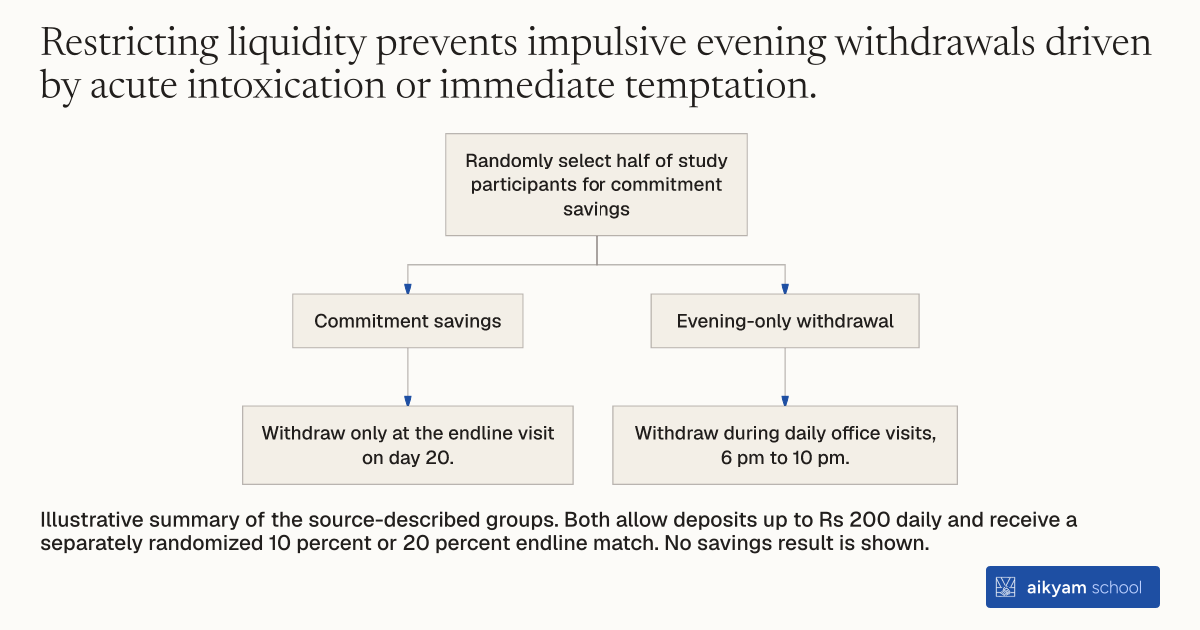
Randomly select half of study participants for commitment savings
- Commitment savings
- Withdraw only at the endline visit on day 20.
- Evening-only withdrawal
- Withdraw during daily office visits, 6 pm to 10 pm.
Illustrative summary of the source-described groups. Both allow deposits up to Rs 200 daily and receive a separately randomized 10 percent or 20 percent endline match. No savings result is shown.
See source →How
When to use
Low-income workers face self-control problems and immediate liquid temptations that hinder wealth accumulation. Standard flexible savings accounts allow premature withdrawals during daily drinking or impulse spending. Use this method to boost net savings among manual laborers by offering dedicated savings boxes with restricted withdrawal rules.
Offer workers individual savings boxes with structured withdrawal restrictions and matching bonuses at a local project office.
- Study staff provide each participant with an individual savings box kept at the field office on day 1.
- Staff permit participants to deposit up to Rs 200 per day from study payments or external income during daily evening office visits between 6 pm and 10 pm.
- Staff assign a randomly selected half of participants to a commitment savings feature that restricts withdrawal until the study endline visit on day 20.
- Staff assign non-commitment participants a weak commitment savings feature that allows withdrawals only during evening office hours between 6 pm and 10 pm.
- Staff pay out accumulated savings plus a randomly assigned 10 percent or 20 percent matching bonus during the endline visit.
Why it works
Coupling withdrawal illiquidity with matching bonuses enhances intertemporal incentives to accumulate financial assets.
Example
In Chennai, cycle-rickshaw drivers given commitment savings accounts accrued Rs 648 in cumulative savings compared to Rs 306 in the uncommitted control group. The savings commitment feature alone increased daily net savings by Rs 4.68 to Rs 5.31 (a 23 to 26 percent increase over control), operating as a direct substitute for sobriety incentives.
About the study
Participants
229 male cycle-rickshaw drivers aged 25 to 60 in Chennai, India.
Study Design
Cross-randomized 3-week field experiment testing commitment savings (no withdrawal until endline vs. evening-only withdrawal) and matching contributions (10 percent vs. 20 percent).
Results
Commitment savings increased average daily savings by Rs 4.68 to Rs 5.31 from a control mean of Rs 20.42, with no additional effect when combined with sobriety incentives.