Research allocation
Compare endline savings matches
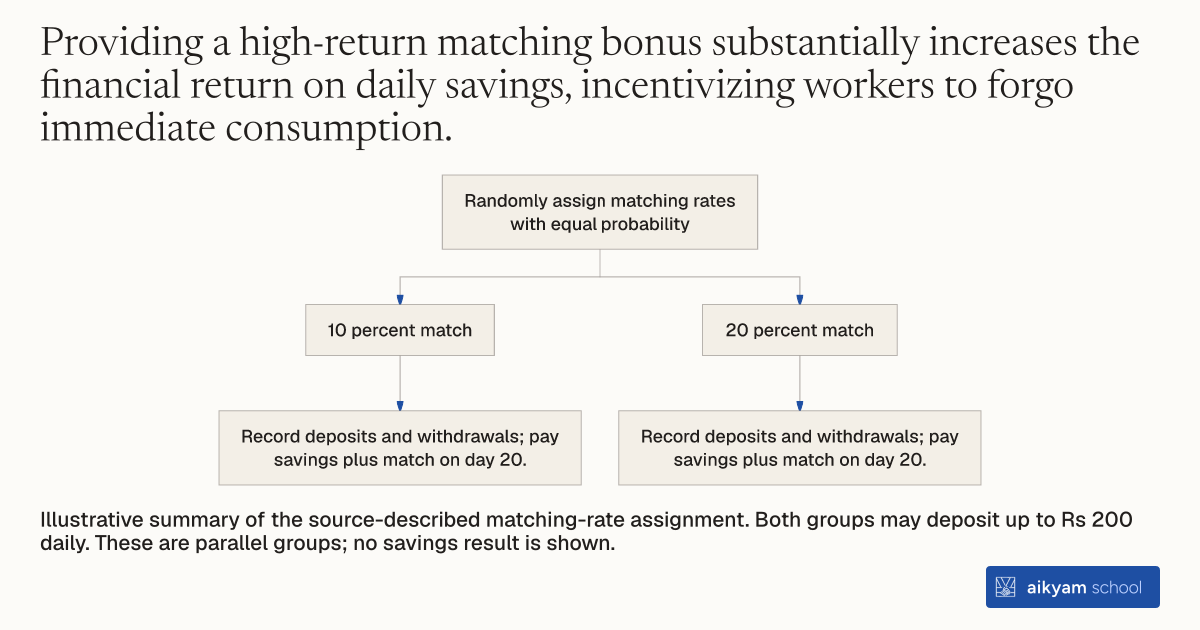
Randomly assign matching rates with equal probability
- 10 percent match
- Record deposits and withdrawals; pay savings plus match on day 20.
- 20 percent match
- Record deposits and withdrawals; pay savings plus match on day 20.
Illustrative summary of the source-described matching-rate assignment. Both groups may deposit up to Rs 200 daily. These are parallel groups; no savings result is shown.
See source →How
When to use
Low-income manual laborers face low interest rates on formal savings and high immediate temptations to spend daily income. Standard savings opportunities without financial returns fail to motivate long-term wealth accumulation among low-wage workers. Use this method to incentivize voluntary daily deposits by offering high-return matching contributions paid out upon study completion.
Offer daily deposit facilities coupled with a guaranteed endline matching contribution to encourage consistent capital accumulation.
- Study staff inform participants on day 1 that they can deposit money into an individual office savings box during daily evening visits.
- Staff randomly assign each participant a matching contribution rate of either 10 percent or 20 percent on total accumulated deposits.
- Staff allow participants to deposit up to Rs 200 per day using study earnings or external labor income.
- Staff keep detailed daily accounting records of all deposits and withdrawals during office visits.
- Staff calculate and disburse the accumulated principal plus the 10 percent or 20 percent matching bonus at the endline visit on day 20.
Why it works
Retaining the match until the study endline visit adds a temporal commitment mechanism that reduces premature withdrawals.
Example
In Chennai, 229 cycle-rickshaw drivers were offered daily lockbox savings opportunities paired with a randomized 10 percent or 20 percent endline matching contribution over a 3-week field experiment. Increasing the matching bonus from 10 percent to 20 percent increased daily net savings at the study office by Rs 9.27 to Rs 10.56 per day, doubling the incentive effect on total financial accumulation.
About the study
Participants
229 male cycle-rickshaw drivers aged 25 to 60 in Chennai, India.
Study Design
Randomized controlled trial cross-assigning 10 percent vs. 20 percent endline matching contributions on study lockbox savings over 20 study days.
Results
Offering a 20 percent match instead of a 10 percent match raised average daily savings by Rs 9.27 to Rs 10.56 from a control mean of Rs 20.42.