Research steps
Compare fertilizer plans with purchases
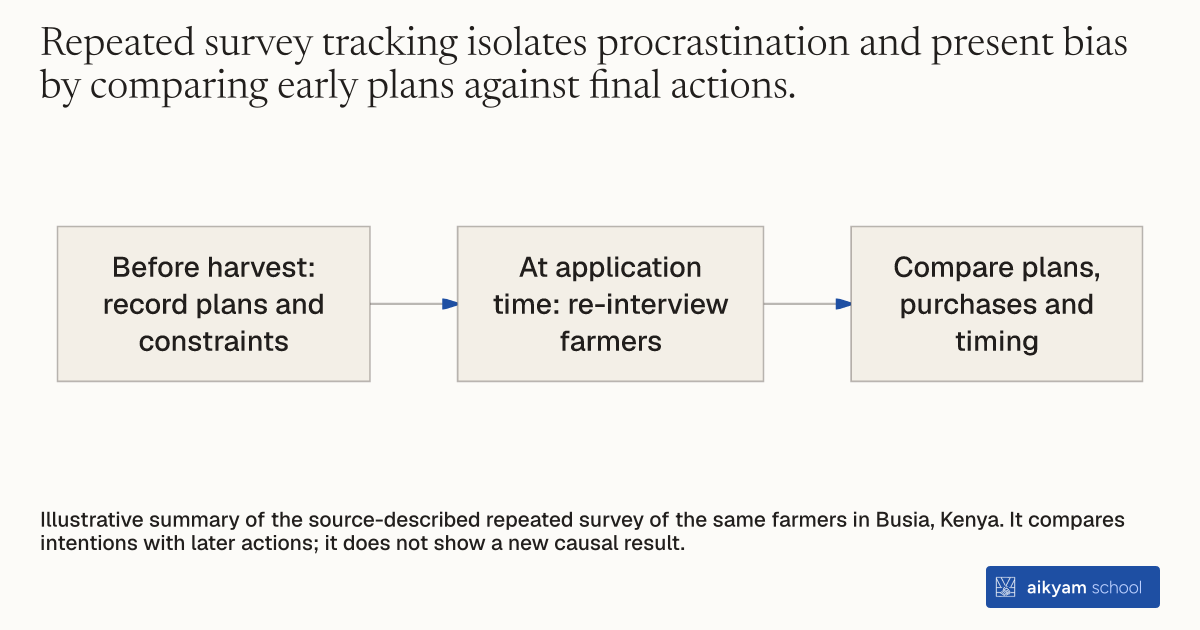
- Before harvest: record plans and constraints
- At application time: re-interview farmers
- Compare plans, purchases and timing
Illustrative summary of the source-described repeated survey of the same farmers in Busia, Kenya. It compares intentions with later actions; it does not show a new causal result.
See source →How
When to use
Development organizations need to diagnose whether low technology adoption stems from financial unaffordability or behavioral self-control failures. Many farmers express explicit intentions to make high-return investments but fail to execute those plans over time. This method surveys farmers at multiple intervals to quantify the gap between early intentions and actual purchasing decisions.
Track investment intentions and purchasing execution across agricultural seasons to identify behavioral procrastination bottlenecks.
- Survey subsistence farmers prior to harvest regarding their planned usage of inorganic fertilizer for upcoming seasons.
- Record initial farmer self-reports on reasons for non-use to identify cash constraints and adoption preferences.
- Re-interview the same farmers during the growing season at input application time to track actual purchasing behavior.
- Document the exact calendar timing of input purchases made relative to application dates.
- Calculate the percentage of intending adopters who fail to purchase and the fraction who delay purchases until application time.
Why it works
It demonstrates that adoption failure often results from intertemporal savings difficulty rather than a lack of intent or knowledge.
Example
Researchers surveyed subsistence maize farmers in Busia district, Kenya, finding that two thirds of farmers who planned to use fertilizer failed to follow through, and 96 to 98 percent of users delayed purchasing until right before application.
About the study
Participants
Subsistence maize farmers in Busia district, western Kenya, where baseline fertilizer usage was 29 percent across prior seasons.
Study Design
Observational survey tracking and behavioral monitoring embedded within a multi-season randomized evaluation.
Results
Two thirds of farmers who planned to use fertilizer failed to follow through with those plans, and 96 to 98 percent of eventual fertilizer users delayed their purchases until right before application time.