Research steps
Follow jobseekers by phone over two years
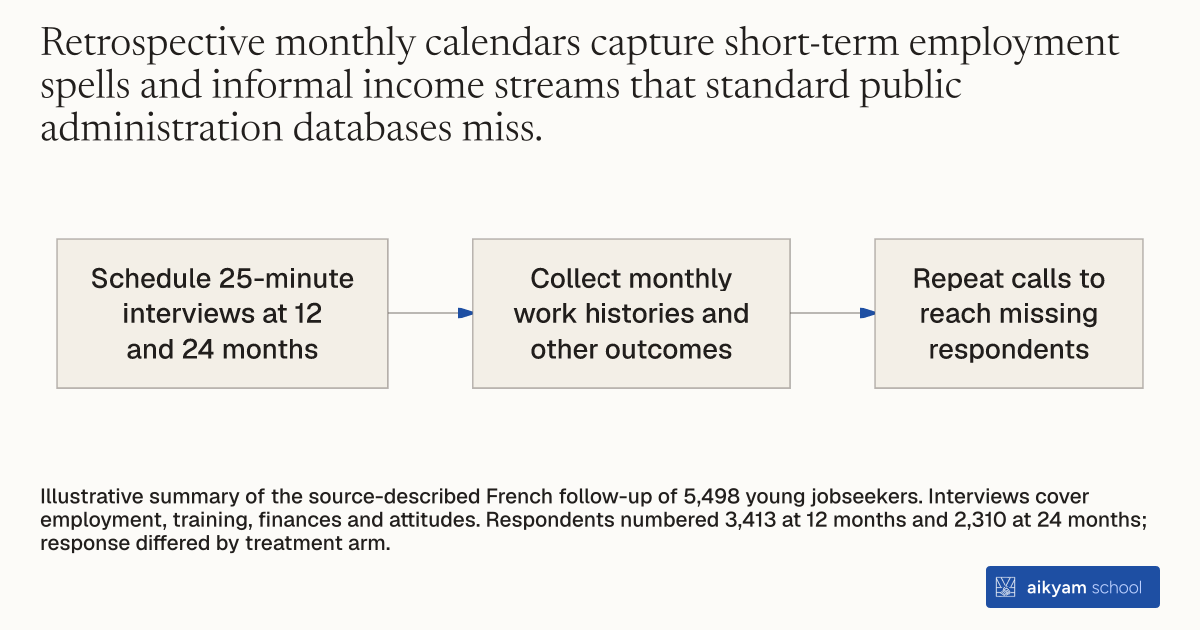
- Schedule 25-minute interviews at 12 and 24 months
- Collect monthly work histories and other outcomes
- Repeat calls to reach missing respondents
Illustrative summary of the source-described French follow-up of 5,498 young jobseekers. Interviews cover employment, training, finances and attitudes. Respondents numbered 3,413 at 12 months and 2,310 at 24 months; response differed by treatment arm.
See source →How
When to use
Administrative records stop tracking participants once jobseekers drop out of public employment centers or lose touch with counselors. Evaluating multi-year employment, income, and behavioral impacts requires following mobile young adults across treatment and control groups over extended time horizons. This method uses structured retrospective phone interviews with intensive recall protocols to track participant outcomes.
Track young trial participants through multi-wave retrospective phone surveys to gather comprehensive labor market and financial data.
- Survey teams schedule individual 25-minute phone interviews at 12-month and 24-month intervals following participant enrollment.
- Interviewers administer retrospective calendar modules recording all full-time and part-time employment events, job types, and training activities month by month over the preceding year.
- Surveyors collect itemized financial data, including earnings, public transfers, parental financial support, bill payment difficulties, and bank savings.
- Surveyors measure psychological traits and attitudes, including locus of control, time preferences, life satisfaction, and trust in local institutions.
- Survey teams make up to 18 or more repeated call attempts per participant to reach mobile jobseekers and maximize response rates across treatment arms.
Why it works
Intensive call persistence reduces survey attrition among disadvantaged youth who frequently change contact details.
Example
In France, evaluators conducted 25-minute phone surveys at 12 months and 24 months across 5,498 young jobseekers aged 18–22, capturing full monthly employment calendars, income substitution, and financial behaviors across 82 Job Youth Centers.
About the study
Participants
3,413 survey respondents at 12 months and 2,310 survey respondents at 24 months from a sample of 5,498 young jobseekers aged 18–22 across 82 Job Youth Centers in France.
Study Design
Longitudinal retrospective phone survey tracking administered at 12-month midline and 24-month endline horizons following randomized treatment assignment.
Results
Survey tracking achieved a 59.3% control response rate at 12 months with a 5.8 percentage point higher treatment response rate, and a 39.5% control response rate at 24 months with a 5.3 percentage point higher treatment response rate, revealing a 3 percentage point early reduction in full-time employment and a net monthly income increase of €40.