Research steps
Collect follow-up data where travel is unsafe
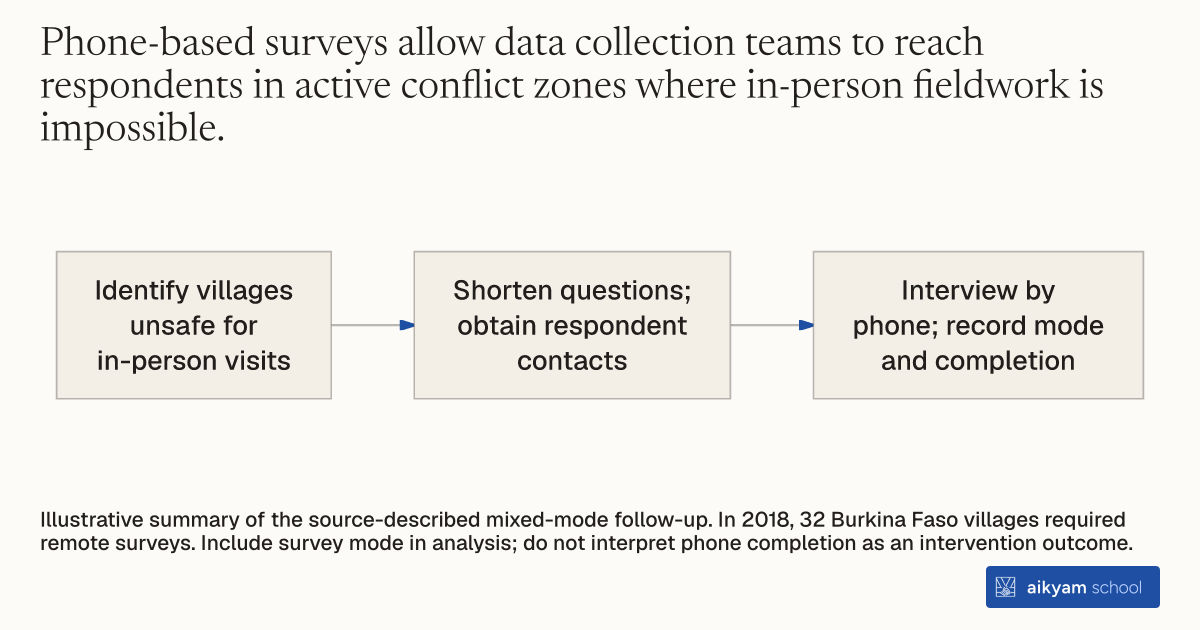
- Identify villages unsafe for in-person visits
- Shorten questions; obtain respondent contacts
- Interview by phone; record mode and completion
Illustrative summary of the source-described mixed-mode follow-up. In 2018, 32 Burkina Faso villages required remote surveys. Include survey mode in analysis; do not interpret phone completion as an intervention outcome.
See source →How
When to use
In social science evaluations conducted across conflict-affected or deteriorating security environments, field teams cannot safely travel to all study villages. Program evaluators need to collect follow-up outcome data without risking surveyor safety or dropping insecure clusters entirely from the sample panel. Switching affected study locations to shortened phone-based interviews preserves panel data collection across high-risk zones.
Transition field survey operations in insecure villages to shortened phone-based interviews to maintain panel tracking during active conflict.
- Monitor local security conditions across all evaluation clusters prior to deploying field survey teams.
- Identify study villages where active conflict or safety threats prevent physical surveyor travel.
- Condense the full field questionnaire into a shortened phone-based survey instrument focused strictly on primary and key secondary outcomes.
- Obtain contact phone numbers for targeted respondents and local health facilities through village contacts or baseline records.
- Survey enumerators conduct remote phone interviews with respondents in inaccessible conflict-affected villages.
- Record phone completion rates and include a survey mode indicator variable in downstream econometric regression models.
Why it works
Condensing the questionnaire to primary metrics reduces interview burden over mobile networks while preserving balance and sample retention across treatment and control groups.
Example
In northern and eastern Burkina Faso, heightened security concerns in 2018 made it impossible to send survey teams to 32 rural sample villages during the endline evaluation. Evaluators administered shortened phone-based questionnaires, successfully interviewing 11.5 percent of women and 5 percent of health clinics over the phone with balanced completion rates across treatment and control groups.
About the study
Participants
7,515 women and 461 clinics across 252 rural villages in Burkina Faso, including 32 insecure villages surveyed remotely.
Study Design
Mixed-mode panel survey protocol combining in-person household visits with shortened phone interviews across high-security risk zones.
Results
Implementing the phone survey protocol in 32 conflict-affected villages captured 11.5 percent of women endline interviews and 5 percent of clinic endline surveys, maintaining an overall 89.5 percent women follow-up rate.