Try, learn and adjust
Check advice targeting uses prior support
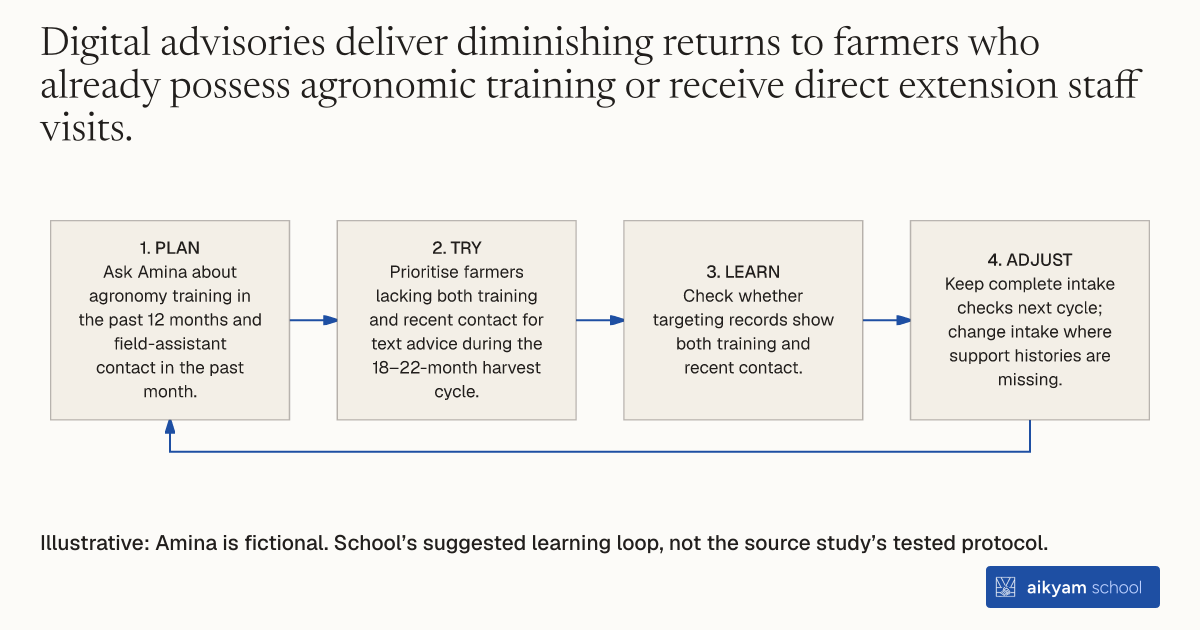
- Plan: Ask Amina about agronomy training in the past 12 months and field-assistant contact in the past month.
- Try: Prioritise farmers lacking both training and recent contact for text advice during the 18–22-month harvest cycle.
- Learn: Check whether targeting records show both training and recent contact.
- Adjust: Keep complete intake checks next cycle; change intake where support histories are missing.
Illustrative: Amina is fictional. School’s suggested learning loop, not the source study’s tested protocol.
See source →School’s suggested learning loop; not a tested source procedure. Observe prior training, recent extension contact and advisory targeting. The source reports subgroup differences; this loop does not establish targeting effects.
How
When to use
Extension providers face constrained budgets and need to maximize the impact of digital advisory interventions across heterogeneous smallholder populations. Traditional extension programs often deliver redundant advice to highly trained or well-supported farmers. Screening target populations by baseline training and extension agent interaction focuses digital advisories where information deficits and potential yield gains are highest.
Screen and prioritize target smallholder farmers based on baseline agricultural training and extension agent contact to maximize information returns.
- Field officers survey candidate farmers during program intake regarding their participation in formal agronomy training over the preceding 12 months.
- Field staff record whether candidate farmers spoke to a company field assistant in the preceding month.
- Program managers categorize farmers who lack formal agronomy training and recent extension contact as high-priority information targets.
- System administrators send personalized text advisories to these high-priority farmers throughout the 18-to-22-month sugarcane harvest cycle.
Why it works
Untrained and unvisited smallholders face the largest information bottlenecks, making automated task reminders far more effective at improving their farm management.
Example
Researchers and Mumias Sugar Company evaluated yield impacts across 1,342 smallholder sugarcane plots in Western Kenya using baseline survey data. Receiving SMS advisories increased yields by 7.53 tons per hectare among farmers without baseline agronomy training compared to trained farmers. Farmers without prior extension staff visits gained 5.58 tons per hectare from text advisories, whereas farmers already receiving staff visits saw no additional yield gain.
About the study
Participants
1,342 smallholder sugarcane plots with baseline survey data in Western Kenya.
Study Design
Subgroup interaction analysis within a field-level Randomized Controlled Trial (RCT) evaluating sugarcane yield impacts against baseline agronomy training and baseline company extension staff interaction.
Results
Yield gains were concentrated among farmers without baseline agronomy training (interaction effect = -7.53 tons/ha, p < 0.05) and those without recent extension staff contact (interaction effect = -5.58 tons/ha, p < 0.05).