Try, learn and adjust
Check cooperative input orders and delivery
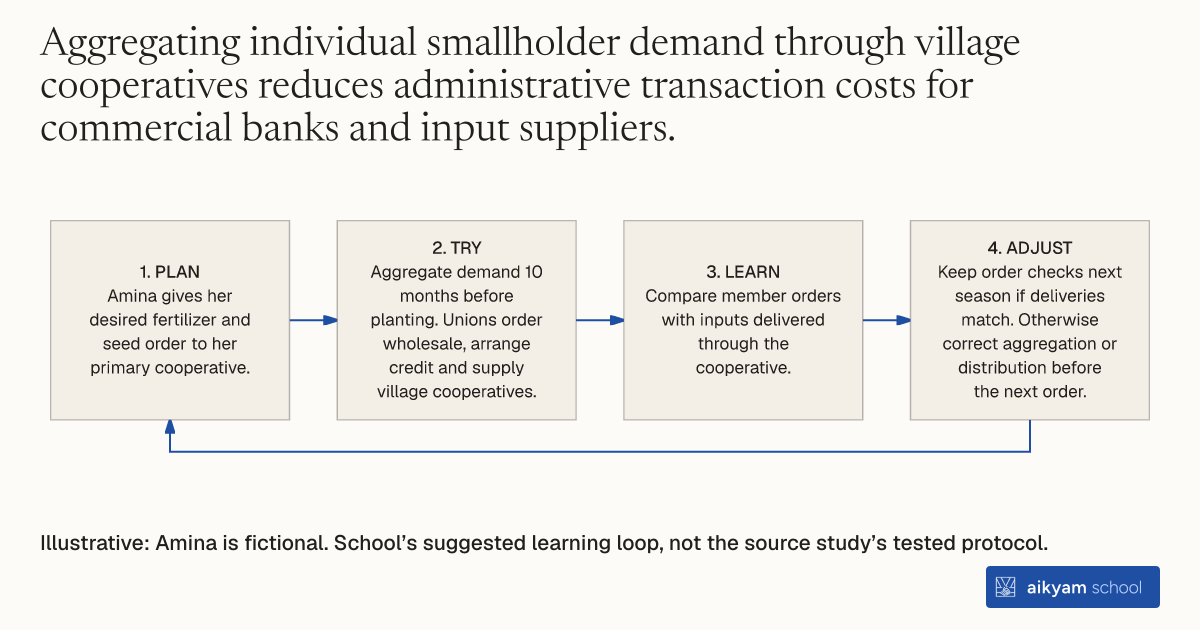
- Plan: Amina gives her desired fertilizer and seed order to her primary cooperative.
- Try: Aggregate demand 10 months before planting. Unions order wholesale, arrange credit and supply village cooperatives.
- Learn: Compare member orders with inputs delivered through the cooperative.
- Adjust: Keep order checks next season if deliveries match. Otherwise correct aggregation or distribution before the next order.
Illustrative: Amina is fictional. School’s suggested learning loop, not the source study’s tested protocol.
See source →School’s suggested learning loop: observe member demand, credit and fertilizer delivery; this does not establish effects on farm output.
How
When to use
Smallholder farmers in developing nations face individual credit constraints and high transaction costs when procuring modern agricultural inputs. Centralized commercial banks struggle to deliver small seasonal loans directly to millions of scattered rural households. Use primary cooperative unions to aggregate individual input requests and channel credit and wholesale fertilizer supplies to smallholder members.
Aggregate smallholder input demand and seasonal credit through a multi-tiered cooperative union network.
- Primary cooperatives collect desired chemical fertilizer and seed purchase orders from individual farmer members in each village.
- Primary cooperatives transmit aggregated member demand up to regional Cooperative Unions ten months before planting.
- Cooperative Unions place wholesale fertilizer orders with national supply entities like the Agricultural Input Supply Enterprise.
- Commercial banks release seasonal credit lines to Cooperative Unions based on aggregated demand and government guarantees.
- Cooperative Unions distribute wholesale fertilizer packages down to primary village cooperatives for retail delivery to members.
Why it works
Utilizing local cooperative social networks enables rural lenders to assess local farming needs and administer group credit lines effectively.
Example
In Amhara, Ethiopia, primary cooperatives aggregated input orders across 120 rural Kebeles, channeling seasonal fertilizer to over 50% of surveyed smallholders. Cooperative members who purchased fertilizer spent an average of 1,687 Birr per household, receiving 70% of their input credit directly through primary cooperative networks.
About the study
Participants
2,399 rural smallholder households across 120 Kebeles in 4 zones of Amhara, Ethiopia.
Study Design
Observational survey auditing financial and input distribution channels across primary cooperative memberships.
Results
70% of households obtaining agricultural input credit received it through primary cooperatives. Overall, 55.4% of sample households used Urea and 53.0% used DAP fertilizer, with expenditure averaging 1,687 Birr per purchasing household (30% of total cash income).