Try, learn and adjust
Check recruitment and wages in temporary public work
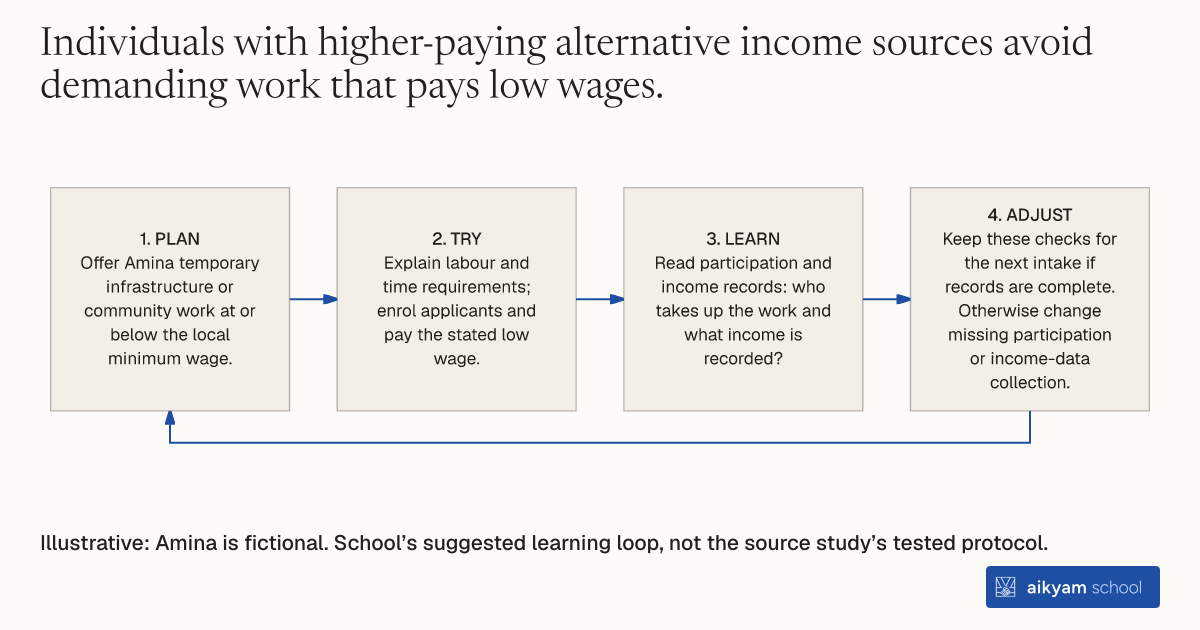
- Plan: Offer Amina temporary infrastructure or community work at or below the local minimum wage.
- Try: Explain labour and time requirements; enrol applicants and pay the stated low wage.
- Learn: Read participation and income records: who takes up the work and what income is recorded?
- Adjust: Keep these checks for the next intake if records are complete. Otherwise change missing participation or income-data collection.
Illustrative: Amina is fictional. School’s suggested learning loop, not the source study’s tested protocol.
See source →School’s suggested learning loop: observe enrolment, wage payments and income. Self-selection is a proposed targeting mechanism, not proof that only the poorest enrol.
How
When to use
Target impoverished individuals who urgently require financial support without incurring high administrative screening costs. Avoid giving scarce aid funds to individuals who already have alternative income sources. Provide immediate short-term income support in low- and middle-income countries.
Set public works wage rates at or below the prevailing minimum wage to recruit workers.
- Offer temporary government-sponsored jobs focused on infrastructure or community service projects.
- Require demanding physical labor and time commitments from all participants.
- Pay workers a low wage rate, such as \$1.80 per day, at or below local minimum wage.
- Allow individuals with better income opportunities to self-select out of applying.
- Enroll the remaining low-income workers into short-term employment slots.
Why it works
Requiring physical labor for low pay automatically ensures that only people most in need choose to register.
Example
In Sierra Leone, a public works program offered participants \$1.80 per day to work on community infrastructure projects, increasing participants' income by 29 percent during the program compared to non-participants.
About the study
Participants
Low-income participants in post-conflict Sierra Leone.
Study Design
Randomized controlled trial measuring participant income during program deployment.
Results
Program participants increased their income by 29 percent during active participation compared to non-participants.