In Simple Words
Imagine giving free bus passes to two people: one who already owns a car and one who has no transportation at all. The car owner barely uses the bus pass and sees little change in daily life, while the person without a car uses it every day to get a job, experiencing a massive life improvement.
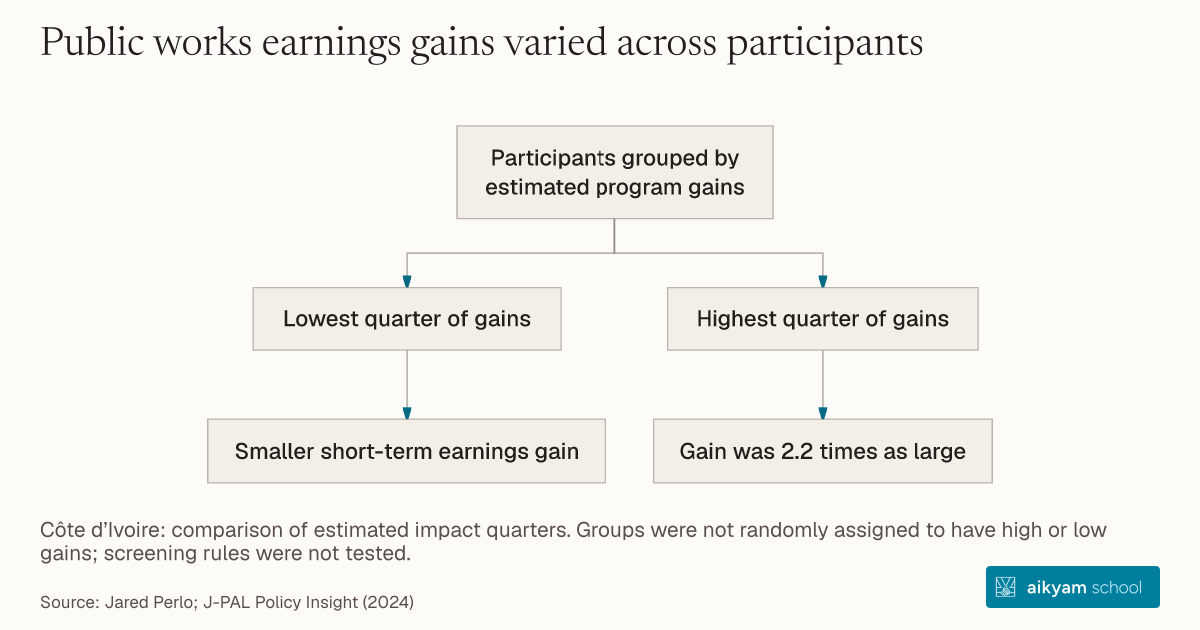
Participants grouped by estimated program gains
- Lowest quarter of gains
- Smaller short-term earnings gain
- Highest quarter of gains
- Gain was 2.2 times as large
Côte d’Ivoire: comparison of estimated impact quarters. Groups were not randomly assigned to have high or low gains; screening rules were not tested.
See source →Research question
Standard evaluations often measure public works impacts using broad population averages, obscuring major differences in benefit distribution among participants. When programs recruit individuals with viable alternative income sources alongside the deeply unemployed, overall net impacts become severely diluted.
Participants
Low-income urban and rural youth participating in public works programs in Côte d'Ivoire.
Study Design
Randomized controlled trial measuring distribution of short-term income gains across participant impact quartiles.
Results
The upper quartile of participants who benefited most from the program saw short-term earnings increase by 2.2 times the earnings gain experienced by participants in the lowest quartile.
Takeaway
Screen applicant baseline employment levels prior to enrollment to select individuals with zero competing labor opportunities.
Source and citation
See source →Read alongside the research
Plain-English glossary
Original explanations, informed by the references below. Examples are illustrations, not data from the studies above. The research text stays unchanged.
- Baseline
The starting measurements in a study. Researchers use these to compare what participants were like at the start with what happens later.
ExampleBefore a training programme starts, researchers measure workers’ earnings. That first measurement is the baseline.
GET-IT glossary · Baseline characteristics ↗Read more about baseline →- Randomized controlled trial
A study that uses chance, like drawing lots, to decide who receives each option being compared. Researchers compare the groups’ outcomes to estimate the effect of those options.
ExampleA lottery assigns volunteers to a training programme or a comparison group. Researchers then compare their outcomes.
GET-IT glossary · Randomized study ↗Read more about randomized controlled trial →