Try, learn and adjust
Check energy disclosures before a home sale
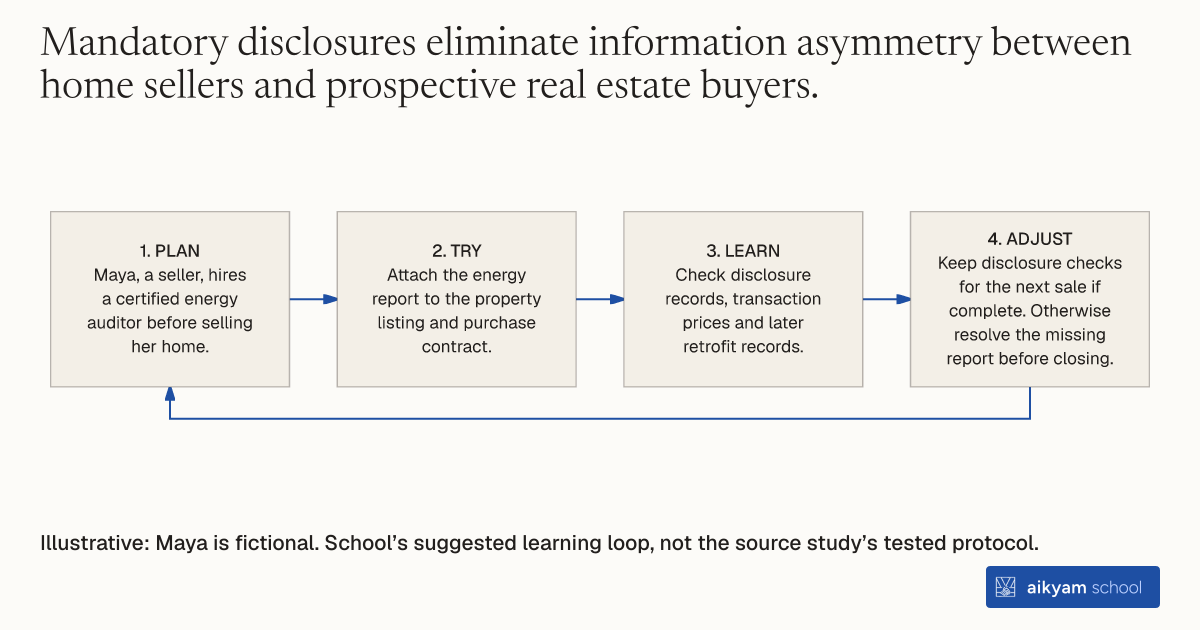
- Plan: Maya, a seller, hires a certified energy auditor before selling her home.
- Try: Attach the energy report to the property listing and purchase contract.
- Learn: Check disclosure records, transaction prices and later retrofit records.
- Adjust: Keep disclosure checks for the next sale if complete. Otherwise resolve the missing report before closing.
Illustrative: Maya is fictional. School’s suggested learning loop, not the source study’s tested protocol.
See source →School’s suggested, untested learning loop. Observe energy ratings, disclosure before closing, sale prices and later retrofits; this loop does not establish price effects.
How
When to use
Prospective home buyers cannot observe energy efficiency features before purchasing real estate property. Information asymmetry causes home buyers to undervalue building energy efficiency in purchase price negotiations. Municipalities mandate energy efficiency disclosure policies when existing developments enter the housing market to inform prospective buyers.
Require real estate sellers to disclose certified home energy efficiency ratings to prospective buyers prior to sale closing.
- Municipal governments pass mandatory disclosure statutes for existing building properties entering the housing market.
- Property owners hire certified energy auditors to assess building insulation, heating equipment, and annual energy consumption.
- Auditors generate standardized energy efficiency disclosure reports documenting expected energy usage and utility costs.
- Real estate agents attach official energy efficiency disclosures to public property sales listings and purchase contracts.
- Program officers track housing transaction prices and post-sale building retrofit rates across municipal real estate markets.
Why it works
Transparent energy efficiency metrics allow home buyers to capitalize future utility cost savings directly into real estate purchase prices.
Example
In residential housing markets in the United States and Germany, mandatory energy efficiency disclosures affected property transaction prices. Disclosing energy ratings allowed home buyers to evaluate energy efficiency features during sale negotiations.
About the study
Participants
Residential property transactions across United States housing markets and the German housing market.
Study Design
Quasi-experimental difference-in-differences and regression discontinuity models evaluating housing sales prices following mandatory disclosure mandates across 3 impact evaluations.
Results
Mandatory energy efficiency disclosures altered residential property prices by revealing building energy performance to prospective buyers, capitalizing energy efficiency into housing market valuations.