Research procedure
Recruit couples around primary schools
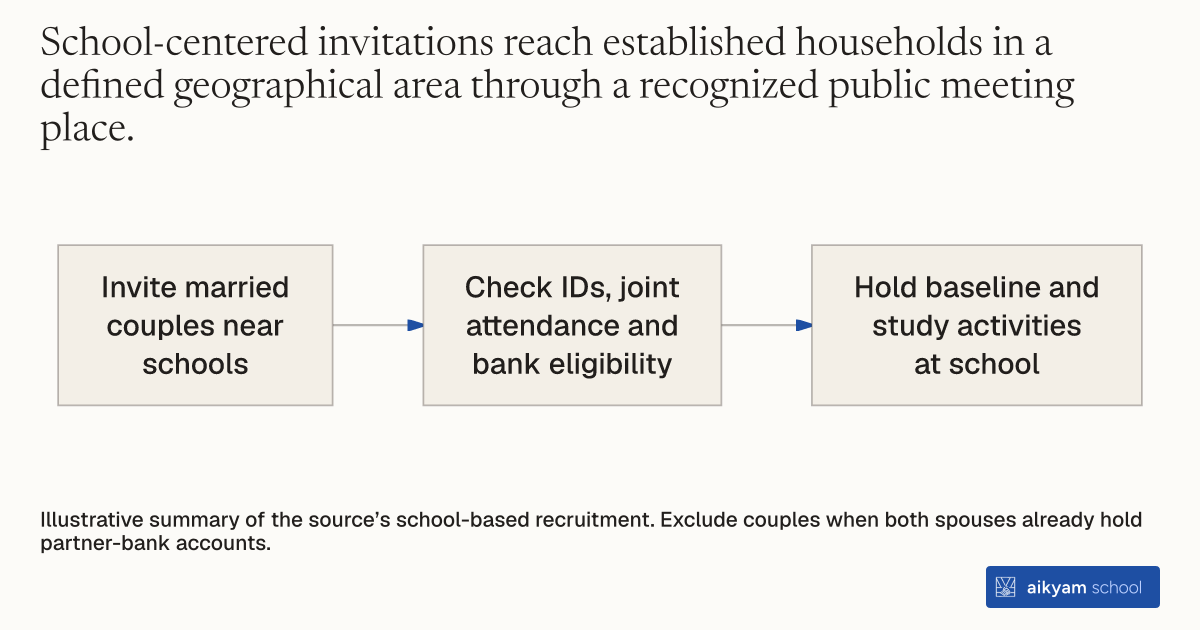
- Invite married couples near schools
- Check IDs, joint attendance and bank eligibility
- Hold baseline and study activities at school
Illustrative summary of the source’s school-based recruitment. Exclude couples when both spouses already hold partner-bank accounts.
See source →How
When to use
Researchers or organizations need to recruit married couples for financial studies or programs in low-income rural communities. Finding eligible pairs who both agree to participate can be difficult without a central community anchor. Partnering with primary schools allows recruiters to reach established households through parent networks.
Invite married parents surrounding primary schools to structured experimental sessions.
- Identify primary schools across targeted rural and semi-urban catchment areas to serve as group meeting grounds.
- Train field officers to issue physical meeting invitations to married couples residing around each school.
- Require both spouses to possess national identification cards and agree to attend the session together.
- Filter out couples where both spouses already hold accounts at the partner financial institution.
- Host group sessions at local primary schools where recruited couples complete baseline surveys and experimental activities.
Why it works
Requiring both partners to attend together ensures full couple participation and verified national identification at the start of the study.
Example
Trained field officers invited married couples in Western Kenya surrounding 19 primary schools near Busia town to attend bank account experimental meetings. Out of eligible issued invitations, 29 percent were redeemed, resulting in 544 non-polygamous married couples participating in the study.
About the study
Participants
544 non-polygamous married couples residing around 19 primary schools in Western Kenya, with median weekly earnings of Ksh 700 for men and Ksh 300 for women.
Study Design
Field officers issued invitations to married couples around primary school catchment areas, screening for national ID card ownership and lack of existing partner bank accounts.
Results
Approximately 29 percent of issued invitations were redeemed over the course of the study, and 7 percent of otherwise eligible couples were excluded due to pre-existing bank account ownership.