Research design
Randomise temporary account returns
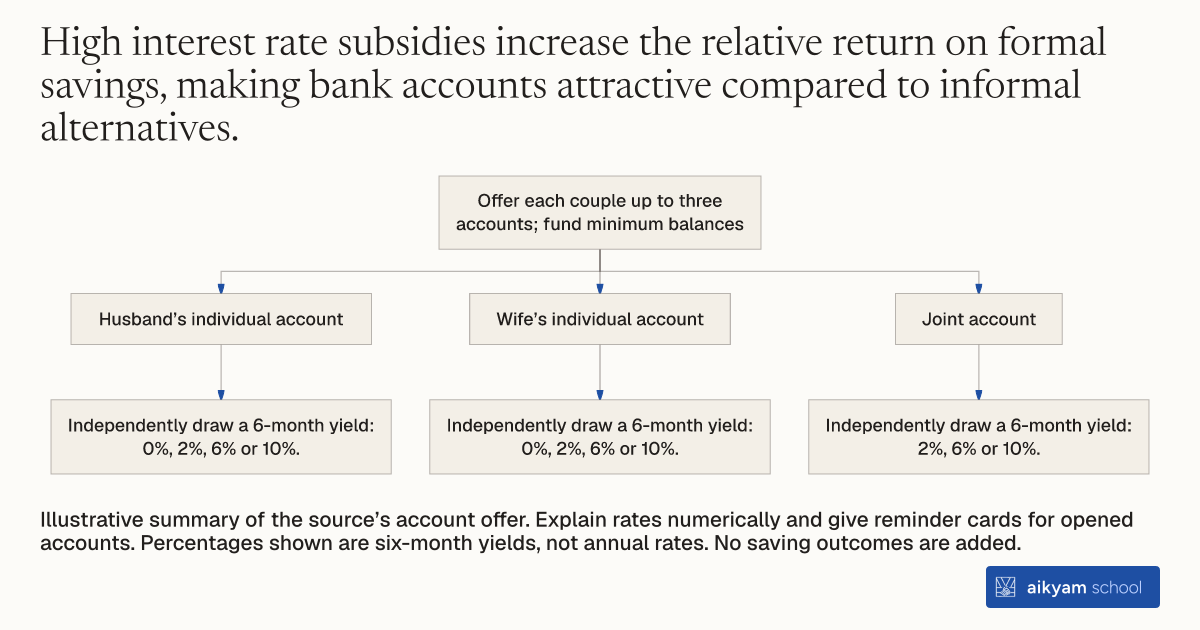
Offer each couple up to three accounts; fund minimum balances
- Husband’s individual account
- Independently draw a 6-month yield: 0%, 2%, 6% or 10%.
- Wife’s individual account
- Independently draw a 6-month yield: 0%, 2%, 6% or 10%.
- Joint account
- Independently draw a 6-month yield: 2%, 6% or 10%.
Illustrative summary of the source’s account offer. Explain rates numerically and give reminder cards for opened accounts. Percentages shown are six-month yields, not annual rates. No saving outcomes are added.
See source →How
When to use
Organizations want to encourage formal bank savings and test intrahousehold allocation decisions among married couples in rural developing contexts. Low baseline interest rates and high transaction costs often prevent low-income households from utilizing formal bank accounts effectively. Offering subsidized, randomized interest rates across individual and joint accounts provides structured incentives to study and promote formal savings.
Offer married couples the opportunity to open individual and joint bank accounts bearing randomly assigned temporary interest rates subsidized by the project.
- Partner with a commercial bank to offer low-barrier savings accounts that require no recurring maintenance fees and a small minimum operating balance.
- Fund the minimum operating balance for every account opened during group meetings so account opening is free to participants.
- Allow each couple to open up to three distinct bank accounts: an individual account for the husband, an individual account for the wife, and a joint account.
- Assign interest rates to each potential account independently via randomized draws, offering 6-month yields of 0, 2, 6, or 10 percent for individual accounts and 2, 6, or 10 percent for joint accounts.
- Provide clear numerical examples of interest rates to participants and issue reminder cards specifying the assigned temporary interest rate for every opened account.
Why it works
Independent randomization of interest rates across individual and joint accounts creates exogenous variation in relative returns to evaluate household financial choices.
Example
In Western Kenya near Busia town, 544 married couples were offered up to three Family Bank accounts with funded Ksh 100 operating balances and randomly assigned 6-month interest rates up to 20 percent annualized, resulting in 44 percent of couples depositing money in at least one account over six months with an average daily balance over Ksh 1,000.
About the study
Participants
544 married couples in rural Western Kenya near Busia town, with median weekly earnings of Ksh 700 for men and Ksh 300 for women.
Study Design
Randomized controlled trial offering up to three bank accounts per couple with funded minimum balances and independent randomly assigned 6-month interest rates (0, 4, 12, or 20 percent annualized for individual; 4, 12, or 20 percent for joint).
Results
Higher temporary interest rates significantly increased account opening and use, with 44 percent of couples saving in at least one account over the first six months and making an average of 3 deposits.