Research procedure
Survey employment by phone
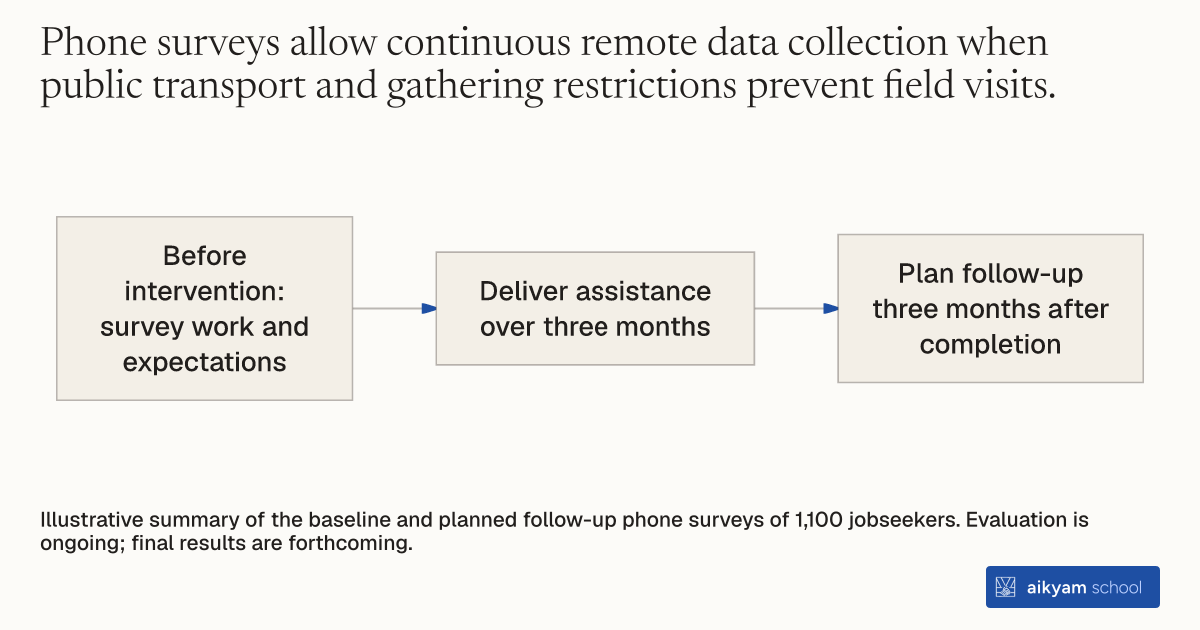
- Before intervention: survey work and expectations
- Deliver assistance over three months
- Plan follow-up three months after completion
Illustrative summary of the baseline and planned follow-up phone surveys of 1,100 jobseekers. Evaluation is ongoing; final results are forthcoming.
See source →How
When to use
Researchers and project managers need to evaluate youth employment and income outcomes when physical data collection is restricted by public health lockdowns. In-person interviewing can be impossible during health crises or across scattered rural locations. Phone surveys enable researchers to track labor market status and expectations remotely across baseline and follow-up periods.
Measure youth employment outcomes and expectations using structured phone surveys administered before and after an intervention.
- Administer a baseline phone survey to participants prior to beginning the intervention.
- Collect data on participants' employment status before and during lockdown conditions.
- Record candidates' expectations regarding their future livelihoods in the near future.
- Implement the randomized post-training assistance intervention over three months.
- Conduct a follow-up phone survey three months after intervention completion to assess changes in employment and earnings.
Why it works
Gathering baseline data before the intervention establishes pre-existing employment levels and expectation benchmarks across study arms.
Example
J-PAL researchers conducted baseline phone surveys with 1,100 young jobseekers across rural and peri-urban Maharashtra, India to record employment status and future expectations before and during COVID-19 lockdowns. Researchers scheduled a final phone survey three months post-intervention in 2021 to measure changes in employment rates and income.
About the study
Participants
1,100 young jobseekers from 96 predefined groups in peri-urban and rural Maharashtra, India.
Study Design
Randomized controlled trial tracking 1,100 candidates across four intervention arms using baseline and 3-month post-intervention follow-up phone surveys.
Results
Evaluation is ongoing and final results are forthcoming; baseline phone surveys successfully measured employment status before and during lockdowns across all 1,100 participants.