Research steps
Measure water contamination
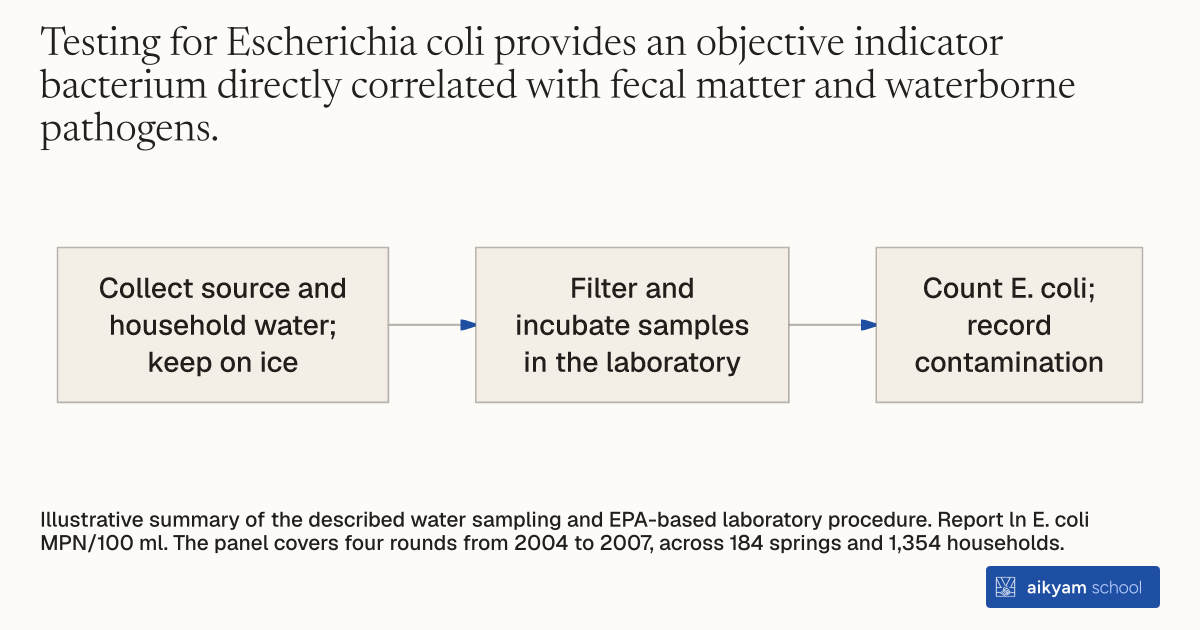
- Collect source and household water; keep on ice
- Filter and incubate samples in the laboratory
- Count E. coli; record contamination
Illustrative summary of the described water sampling and EPA-based laboratory procedure. Report ln E. coli MPN/100 ml. The panel covers four rounds from 2004 to 2007, across 184 springs and 1,354 households.
See source →How
When to use
Water from rural drinking sources and household storage vessels often contains invisible microbial pathogens that cause diarrheal illness. Evaluators need a standard diagnostic method to quantify fecal contamination levels at sources and inside homes. Systematic water sampling establishes precise baseline contamination levels and measures health risk reductions from clean water interventions.
Measure microbial fecal contamination in drinking water sources and household storage containers using standard coliform testing protocols.
- Survey enumerators collect water samples from water sources and household storage containers using sterile vessels.
- Field staff transport collected water samples in insulated cooler boxes with ice to maintain temperature control.
- Laboratory staff process samples using EPA-based membrane filtration protocols to isolate microbial indicator bacteria.
- Laboratory staff incubate filtered samples to culture colony-forming units of Escherichia coli.
- Laboratory staff count bacterial colonies to calculate the natural log of the most probable number of colony-forming units per 100 ml of water.
Why it works
Standardized EPA laboratory protocols eliminate subjective recall bias and quantify exact microbial contamination at both source water points and household storage containers.
Example
In Busia and Butere-Mumias districts in western Kenya, survey staff collected water samples across 184 viable springs and 1,354 user households over four survey rounds from 2004 to 2007, recording baseline source contamination averaging 3.6 ln E. coli MPN/100 ml.
About the study
Participants
184 viable springs and 1,354 user households across Busia and Butere-Mumias districts in Western Province, Kenya.
Study Design
Panel study over four survey rounds (2004–2007) collecting water samples at sources and in homes using EPA-based coliform testing protocols.
Results
Spring protection reduced source water E. coli contamination by 66% (-1.07 ln E. coli MPN/100 ml) and household water contamination by 24% (-0.27 ln E. coli MPN/100 ml).