Research procedure
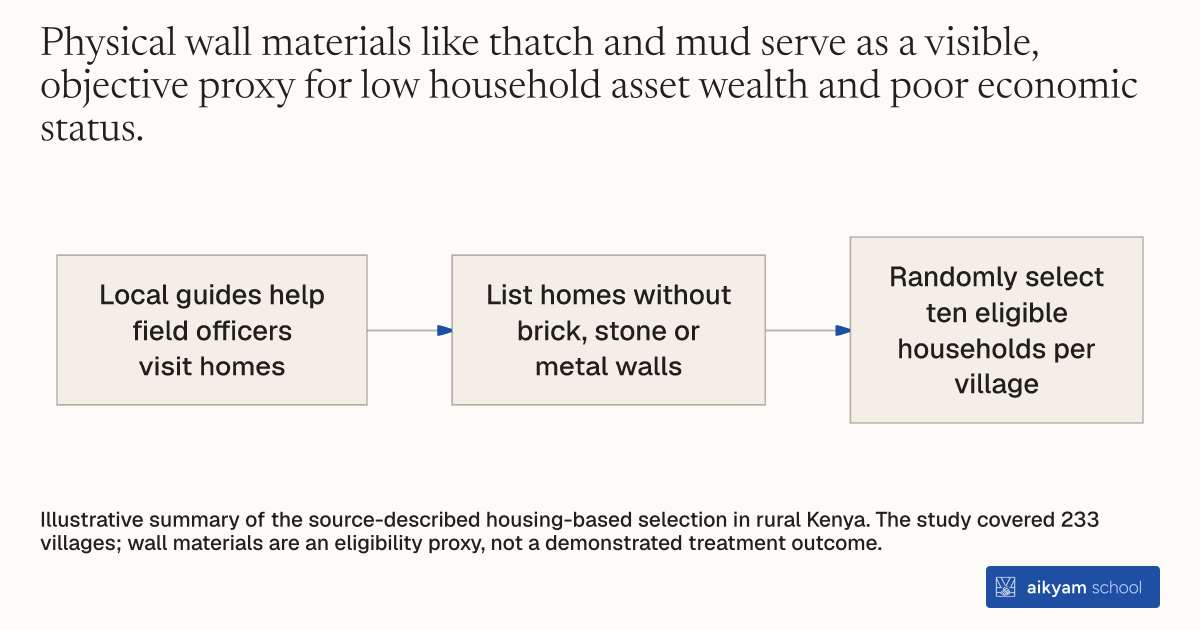
Sample households using visible wall materials
- Local guides help field officers visit homes
- List homes without brick, stone or metal walls
- Randomly select ten eligible households per village
Illustrative summary of the source-described housing-based selection in rural Kenya. The study covered 233 villages; wall materials are an eligibility proxy, not a demonstrated treatment outcome.
See source →How
When to use
Low-income rural communities often lack official financial or income records to identify poor households for aid programs. This method identifies impoverished households using visible physical housing characteristics without requiring complex income verification. It serves anti-poverty programs operating in low-resource rural settings.
Select eligible low-income households by screening housing wall materials during community field visits.
- Village elders assign local guides to assist field officers upon entering a target village.
- Field officers and local guides visit village dwellings to identify households meeting structural poverty criteria.
- Field officers screen each house and include only households living in dwellings constructed without brick, stone, or metal walls.
- Field officers compile a complete roster list of all eligible thatched or mud-wall households within the village.
- Field officers randomly select ten eligible households from the village roster list to participate in the program.
Why it works
This physical screening allows field teams to identify low-income households transparently without costly administrative audits.
Example
In rural Nakuru County, Kenya, field officers collaborated with local guides across 233 villages to identify eligible low-income households. The teams listed households living in homes without brick, stone, or metal walls, and randomly selected 10 eligible households per village to participate in the evaluation.
About the study
Participants
5,756 low-income individuals across 233 rural villages in Nakuru County, Kenya, where 33 percent of participants met criteria for psychological distress at baseline.
Study Design
A randomized controlled trial across 233 villages comparing an unconditional cash transfer, a five-week CBT-based psychotherapy program, and a combined treatment against a control group, with household selection based on housing wall materials.
Results
Housing-targeted unconditional cash transfers of USD 1,076 PPP increased monthly consumption by 20 percent (USD 10.40 PPP), asset holdings by 49 percent (USD 272.16 PPP), revenue by 27 percent (USD 36.32 PPP), and psychological well-being by 0.24 standard deviations relative to pure control households after one year.