Trial procedure
Compare wage timing
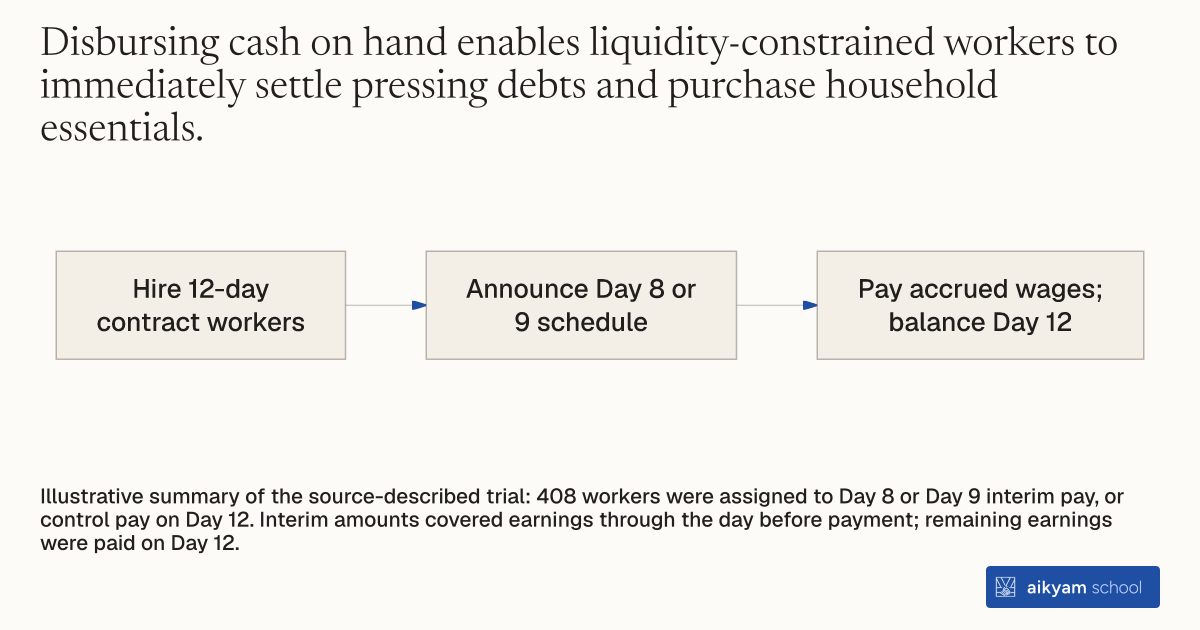
- Hire 12-day contract workers
- Announce Day 8 or 9 schedule
- Pay accrued wages; balance Day 12
Illustrative summary of the source-described trial: 408 workers were assigned to Day 8 or Day 9 interim pay, or control pay on Day 12. Interim amounts covered earnings through the day before payment; remaining earnings were paid on Day 12.
See source →How
When to use
Provide mid-contract wage liquidity to daily wage workers who face severe cash shortfalls and outstanding debt during agricultural lean seasons. It addresses the problem of cognitive strain and off-task worries that impair worker focus and output during contract work. It serves piece-rate workers and employers seeking to boost manufacturing output without raising piece rates or changing total contract compensation.
Disburse accrued wages as an interim mid-contract liquidity payment to casual workers rather than holding all earnings until contract completion.
- Hire casual laborers for 12-day contract manufacturing rounds during agricultural off-seasons.
- Inform workers upon arrival that accrued wages may be paid in two installments rather than a single lump sum at contract end.
- Announce individual payment schedules on Day 5 to inform workers whether their interim payout occurs on Day 8 or Day 9.
- Calculate accrued earnings to date up to the day before payment so output on payment day itself does not alter the disbursement amount.
- Distribute accrued earnings privately in cash to treated workers at the end of their assigned payment day, leaving remaining earnings for disbursement on Day 12.
Why it works
Clearing these urgent background worries reduces mental rumination, allowing workers to focus on manufacturing tasks with fewer attentional lapses.
Example
In rural Odisha, India, 408 piece-rate leaf-plate makers were assigned to either a control group paid on Day 12 or a treatment group receiving an interim payment of accrued earnings on Day 8 or 9. Treated workers immediately increased loan payments by 287% and household spending by 70% on payment day, boosting hourly output by 6.9% (0.109 SDs) and reducing attentional mistakes by 0.08 SDs over subsequent days.
About the study
Participants
408 male casual manufacturing workers aged 18 to 55 across 14 experimental rounds in rural Odisha, India.
Study Design
RCT comparing control workers paid in a single lump sum on Day 12 against treatment workers receiving accrued earnings in two installments (interim pay on Day 8 or Day 9 and remaining balance on Day 12), holding piece rates and total contract pay constant.
Results
Treated workers increased output by 0.109 SDs (6.9%, p=0.020) and reduced attentional lapses by 0.08 SDs (p=0.092), with productivity gains reaching 0.204 SDs (13.0%, p=0.003) among poorer workers.