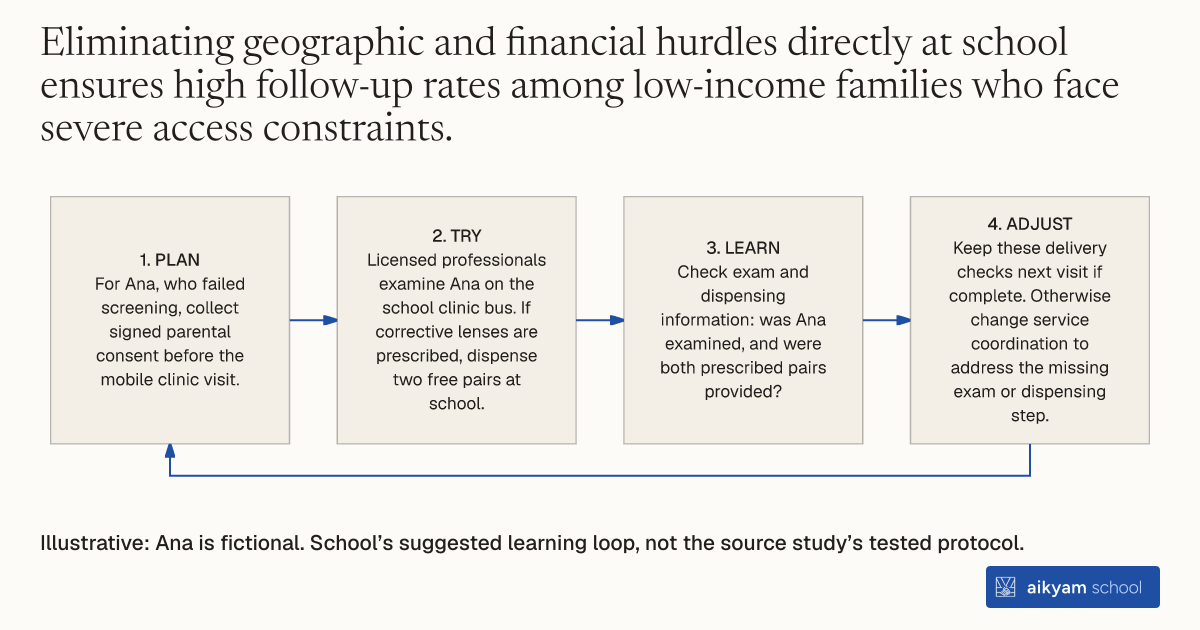
Try, learn and adjust
Check authorised students receive exams and prescribed glasses
- Plan: For Ana, who failed screening, collect signed parental consent before the mobile clinic visit.
- Try: Licensed professionals examine Ana on the school clinic bus. If corrective lenses are prescribed, dispense two free pairs at school.
- Learn: Check exam and dispensing information: was Ana examined, and were both prescribed pairs provided?
- Adjust: Keep these delivery checks next visit if complete. Otherwise change service coordination to address the missing exam or dispensing step.
Illustrative: Ana is fictional. School’s suggested learning loop, not the source study’s tested protocol.
See source →School’s suggested learning loop, not a source-tested procedure. Observe consent, completed exams and glasses provision; clinical care remains with licensed professionals, and learning effects require evaluation.
How
When to use
Low-income elementary school students who fail vision screenings often face financial, geographic, or logistical barriers to visiting an eye clinic. Sending standard warning letters to parents does not resolve these access barriers or lead to eye care follow-up. Bringing mobile optometric services directly to schools delivers comprehensive exams and corrective lenses to underserved children without parental financial or travel constraints.
Deliver comprehensive eye care directly to students at school using a customized mobile clinic equipped as an optometrist office.
- Collect signed parent consent forms at elementary schools following vision screenings.
- Park a mobile vision clinic bus staffed with licensed eye care professionals directly at target elementary schools.
- Conduct comprehensive vision exams aboard the mobile bus for all students who failed screening and submitted permission forms.
- Prescribe custom prescription corrective lenses when visual impairments are confirmed during the exam.
- Dispense two pairs of prescription eyeglasses per student free of charge directly at school.
Why it works
Providing two free pairs ensures students retain corrective lenses even if one pair is misplaced, broken, or left at home.
Example
Florida Vision Quest deployed a mobile vision clinic to Title 1 elementary schools across central Florida, providing 914 vision exams aboard the bus and dispensing two free pairs of eyeglasses to 784 students who failed screening.
About the study
Participants
4,806 fourth and fifth grade students in full-treatment Title 1 elementary schools across central Florida, where over 70% of students were low-income.
Study Design
School-level randomized controlled trial evaluating full-treatment schools (onsite mobile exams + 2 free pairs of glasses) against screen-only and control schools using FCAT test score panels.
Results
Full-treatment provision of free exams and eyeglasses significantly improved 5th-grade academic achievement in math (0.14 to 0.16 SD) and reading (0.11 SD), and boosted English Language Learner scores in both subjects by 0.15 SD.