Research procedure
Collect peer contacts by phone
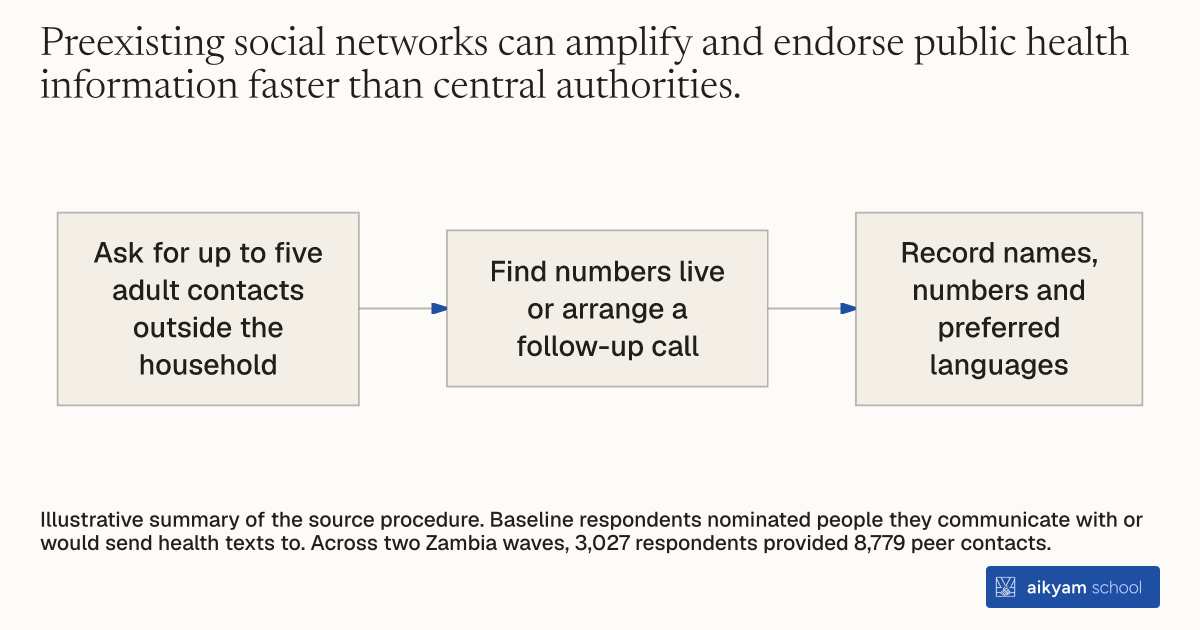
- Ask for up to five adult contacts outside the household
- Find numbers live or arrange a follow-up call
- Record names, numbers and preferred languages
Illustrative summary of the source procedure. Baseline respondents nominated people they communicate with or would send health texts to. Across two Zambia waves, 3,027 respondents provided 8,779 peer contacts.
See source →How
When to use
Public health programs often need to reach local communities through personal networks rather than direct government broadcasting. Finding target individuals without existing directory records presents a major operational hurdle for field teams. Mobile phone contact elicitation enables survey enumerators to systematically gather peer phone numbers from initial survey respondents.
Elicit mobile phone contact details for peer network members from baseline survey respondents during phone interviews.
- Ask baseline survey respondents at the end of a phone questionnaire to provide names and phone numbers for up to five adult contacts outside their household.
- Inform respondents that nominated contacts must be adults outside their household with whom they regularly communicate or are willing to share health SMSs.
- Guide respondents with speakerphone capability through phone menu settings to locate contact lists during the live call.
- Ask respondents without speakerphones to write down numbers on paper and schedule a follow-up phone call to collect the list.
- Record preferred local languages for every provided contact to prepare formatted health messages.
Why it works
Gathering phone contact details from initial study participants builds a secondary population sample connected by direct social ties.
Example
In Zambia, survey enumerators asked 3,027 baseline respondents to provide up to five peer contacts, generating a sample of 8,779 peer participants across two implementation waves.
About the study
Participants
3,027 primary participants provided 8,779 peer contacts in Zambia, who were then contacted for follow-up surveys.
Study Design
Enumerators collected names, mobile phone numbers, and preferred languages for up to five peer contacts per primary participant during phone baseline surveys, re-contacting respondents later if phone lists needed manual lookup.
Results
3,027 baseline respondents identified 8,779 peer contacts, of whom 62% in the reference group were successfully reached and surveyed by phone enumerators in subsequent rounds.