Try, learn and adjust
Check inclusive discussion and expert questions
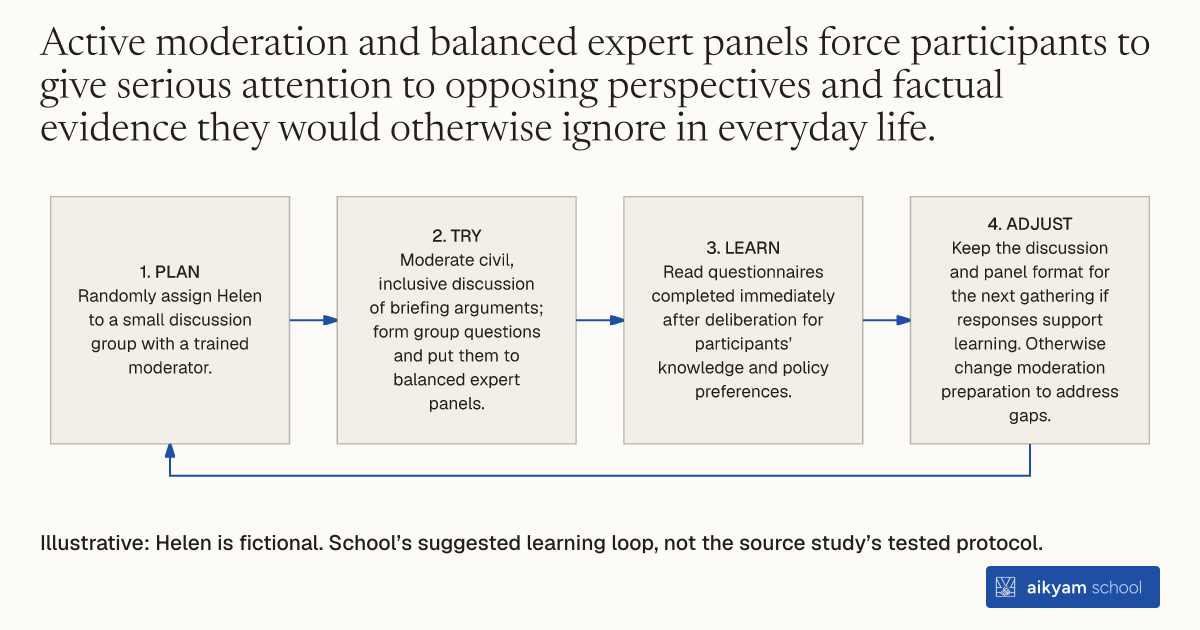
- Plan: Randomly assign Helen to a small discussion group with a trained moderator.
- Try: Moderate civil, inclusive discussion of briefing arguments; form group questions and put them to balanced expert panels.
- Learn: Read questionnaires completed immediately after deliberation for participants’ knowledge and policy preferences.
- Adjust: Keep the discussion and panel format for the next gathering if responses support learning. Otherwise change moderation preparation to address gaps.
Illustrative: Helen is fictional. School’s suggested learning loop, not the source study’s tested protocol.
See source →Observe questionnaire responses after deliberation. This loop is not the study’s randomised topic-order design. School’s suggested learning loop; not a tested source procedure.
How
When to use
In everyday life, political discussions often occur among like-minded individuals, leading to unreflective reactions and polarising echo chambers. Organisers implement structured small-group discussions and expert panels for representative citizen cohorts facing complex policy choices. This enables participants to examine alternative viewpoints civilly and ask targeted questions to informed policy experts.
Convene randomly assigned small groups of diverse citizens alongside balanced plenary panels to deliberate public policy options under active moderation.
- Assign participants randomly to small discussion groups at a common site to ensure socio-demographic and attitudinal diversity.
- Direct trained moderators to guide small-group conversations, ensuring discussions remain on-topic, civil, and inclusive of all arguments from the briefing materials.
- Task each small group with formulating key consensus questions on policy trade-offs to pose to expert panels.
- Convene plenary sessions where small groups put their generated questions to balanced panels of policy experts and advocates.
- Administer comprehensive questionnaires immediately following deliberative sessions to record changes in participants' knowledge and policy preferences.
Why it works
This structured interaction promotes learning, clarifies fundamental policy trade-offs, and aligns individual preferences with broader public reasoning.
Example
Organisers gathered 133 participants randomly assigned to 16 small groups across a weekend in New Haven, Connecticut, to deliberate airport expansion and regional property-tax revenue sharing. Through moderated discussions and expert Q&A panels, participant overall factual knowledge increased by 22.3%, rising from 36.8% at baseline to 59.1% at final testing, while agreement with voluntary tax sharing grew significantly from -0.115 at baseline to 0.241 at T3.
About the study
Participants
Initial interview sample of 1,032 residents from 15 towns surrounding New Haven, Connecticut, with 133 attending the event. Participants were 50.8% male, 49.2% female, 72.7% Caucasian, 12.1% African American, 3% Hispanic or Latino/a, and 90.2% registered voters, with an average age of 50.1 years.
Study Design
Randomized field experiment within a split-half Deliberative Poll featuring 16 small groups randomly assigned to order of deliberation, led by trained moderators and combined with plenary expert panels and questionnaires administered at baseline (T1), midterm (T2), and event completion (T3).
Results
Overall factual knowledge increased across eight test items by 22.3%, moving from 36.8% correct at T1 to 59.1% correct at T3. Proximity to single-peakedness for revenue sharing increased from 0.52 at T1 to 0.80 at T3, while net attitudes toward non-mandatory tax sharing moved from -0.115 at T1 to 0.241 at T3.