Research procedure
Prepare participants before deliberation
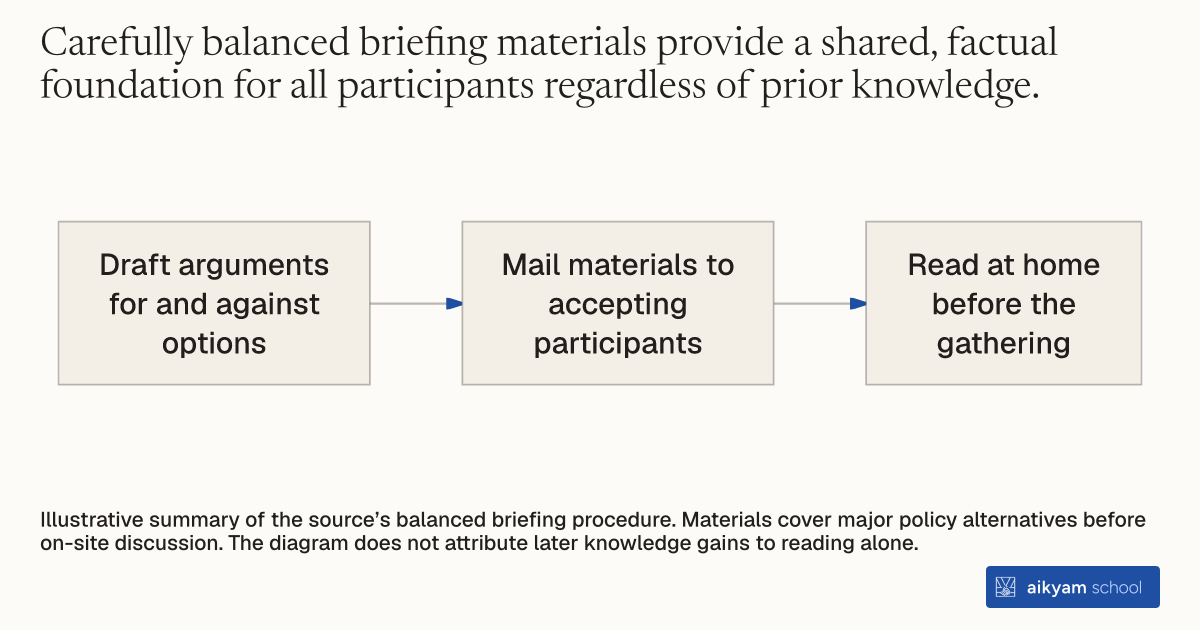
- Draft arguments for and against options
- Mail materials to accepting participants
- Read at home before the gathering
Illustrative summary of the source’s balanced briefing procedure. Materials cover major policy alternatives before on-site discussion. The diagram does not attribute later knowledge gains to reading alone.
See source →How
When to use
Citizens often lack accessible, unbiased information on complex regional policy proposals prior to public consultations. Organisers distribute briefing materials to give participants equal access to competing arguments before discussions begin. This ensures participants jump-start their learning and arrive prepared to discuss policy alternatives thoughtfully.
Distribute balanced briefing materials detailing arguments for and against major policy choices to participants before a deliberative gathering.
- Draft comprehensive briefing materials covering key regional policy proposals and major options.
- Ensure the text presents balanced arguments both for and against each major policy alternative.
- Mail the briefing materials to recruited participants after they agree to attend the deliberative event.
- Allow participants time to read and reflect on the written arguments individually at home prior to arrival.
Why it works
Reading competing arguments before meeting jump-starts participant learning and encourages deeper reflection on policy trade-offs.
Example
Organisers mailed balanced briefing materials on airport expansion and regional property-tax revenue sharing to citizens who agreed to attend the New Haven event. Reading the materials at home contributed to significant factual knowledge gains across both issues prior to the start of on-site discussions, with overall average scores rising from 36.8% at baseline to 55.3% at midterm across participants.
About the study
Participants
Initial interview sample of 1,032 residents from 15 towns surrounding New Haven, Connecticut, with 133 attending the event. Participants were 50.8% male, 49.2% female, 72.7% Caucasian, 12.1% African American, 3% Hispanic or Latino/a, and 90.2% registered voters, with an average age of 50.1 years.
Study Design
Randomized field experiment within a split-half Deliberative Poll where accepting interviewees received briefing materials by mail to read at home prior to participating in on-site small-group discussions and plenary expert panels.
Results
Across the whole sample, factual knowledge on the two revenue-sharing items increased by 34.5%, rising from 25.4% correct at baseline to 59.9% correct at final testing. Factual knowledge on airport items increased from 38.6% at baseline to 54.2% at final testing.