Research flow
Model two water-access options
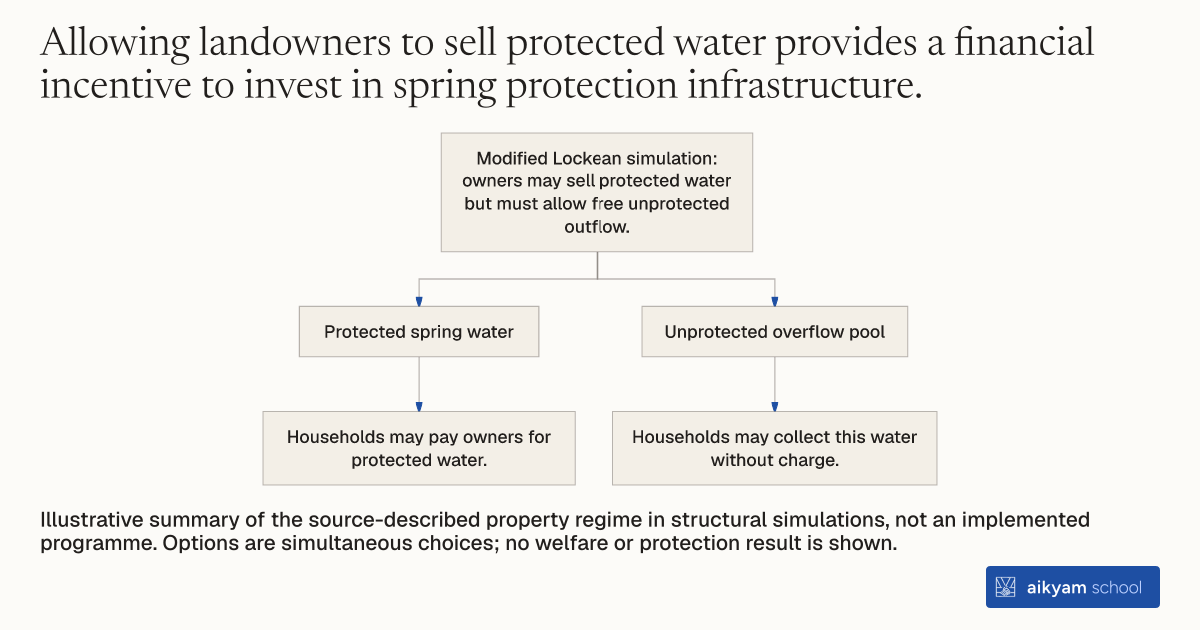
Modified Lockean simulation: owners may sell protected water but must allow free unprotected outflow.
- Protected spring water
- Households may pay owners for protected water.
- Unprotected overflow pool
- Households may collect this water without charge.
Illustrative summary of the source-described property regime in structural simulations, not an implemented programme. Options are simultaneous choices; no welfare or protection result is shown.
See source →How
When to use
Landowners who protect water sources and charge fees create market distortions when poor households shift to dirtier free water sources. Conversely, pure communal property norms provide landowners no financial incentive to fund water infrastructure. Institutional planners need a property regime that incentivizes private infrastructure investment without forcing community members to use dirty water.
Grant conditional property rights allowing landowners to sell protected water while maintaining free public access to unimproved water.
- Policy makers establish legal regulations permitting private landowners to sell water from protected springs on their land.
- Policy makers mandate that landowners who protect springs must allow a portion of water to flow freely outside the concrete structure.
- Landowners allow this diverted outflow to form an open pool of unprotected spring water available to the public without charge.
- Community households choose between purchasing protected spring water or collecting free water from the unprotected pool.
- Private landowners collect user fees from willing buyers to recover infrastructure construction and maintenance costs.
Why it works
Requiring free public access to the unprotected overflow shields households from welfare losses and prevents users from being forced onto dirtier alternative water sources.
Example
In structural simulations across 184 spring communities in western Kenya, a modified Lockean property regime induced private investment to protect 2 percent of springs, generating Pareto improvements over the communal property status quo without reducing any household's utility.
About the study
Participants
Counterfactual simulations across 184 viable spring communities in Busia and Butere-Mumias districts, Kenya.
Study Design
Nash equilibrium structural simulations combining discrete choice revealed preference demand parameters with private profit-maximization models under alternative property regimes.
Results
Modified Lockean property rights protected 2% of springs (including 7% of springs a social planner would protect), achieving a 0.003 log point reduction in average ln E. coli contamination while guaranteeing zero utility loss for non-paying households relative to communal property.