Research steps
Track daily child illness
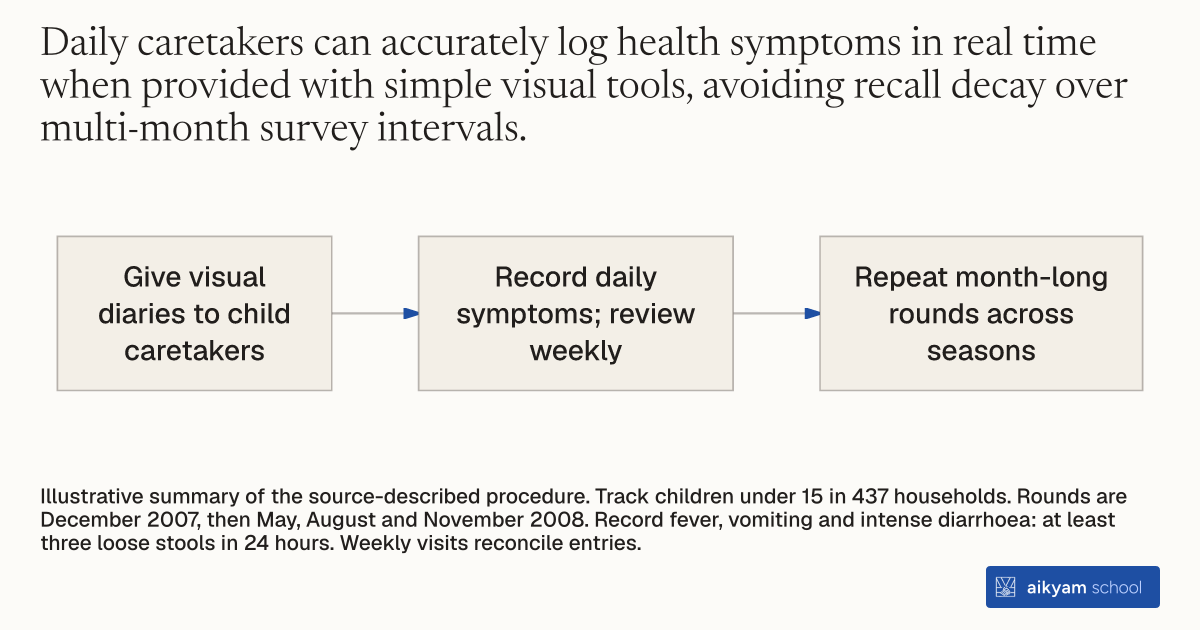
- Give visual diaries to child caretakers
- Record daily symptoms; review weekly
- Repeat month-long rounds across seasons
Illustrative summary of the source-described procedure. Track children under 15 in 437 households. Rounds are December 2007, then May, August and November 2008. Record fever, vomiting and intense diarrhoea: at least three loose stools in 24 hours. Weekly visits reconcile entries.
See source →How
When to use
In health evaluations, household recall over long intervals often suffers from memory bias and underreporting of routine childhood illnesses. This method tracks child illness episodes by providing caretakers with simple structured diaries paired with frequent enumerator visits. It captures precise incidence rates of diarrhea, fever, and vomiting in families with young children.
Track child health using caretakers' daily illness logs verified through weekly enumerator home visits.
- Identify households with children under age 15 during baseline surveys.
- Distribute visual illness diaries designed for low-literacy adult caretakers to mark daily symptoms.
- Instruct primary caretakers to record daily occurrences of fever, vomiting, and intense diarrhea defined as at least three loose stools within 24 hours.
- Surveyors visit households at the end of each week to collect the diary, review symptoms with the female head, and correct entries.
- Repeat month-long tracking rounds across baseline and multiple follow-up seasons in May, August, and November.
Why it works
Weekly surveyor follow-ups ensure diary completeness, reconcile missing entries, and maintain data consistency across measurement rounds.
Example
In Tangiers, Morocco, surveyors monitored 437 households with children under 15 across four month-long tracking rounds in December 2007, May 2008, August 2008, and November 2008. Weekly visits and caretakers' daily diaries showed an average weekly diarrhea rate of 0.254 days per child, revealing that private water connections produced no statistically significant reduction in child diarrhea.
About the study
Participants
437 households with children under 15 years old in Tangiers, Morocco.
Study Design
Four 1-month daily illness diary panels (December 2007 baseline, May/August/November 2008 follow-ups) with weekly enumerator reconciliation visits.
Results
The intervention produced an average effect over three follow-ups of 0.001 additional weekly days with intense diarrhea relative to a control group mean of 0.254 days.