Try, learn and adjust
Check monsoon insurance delivery
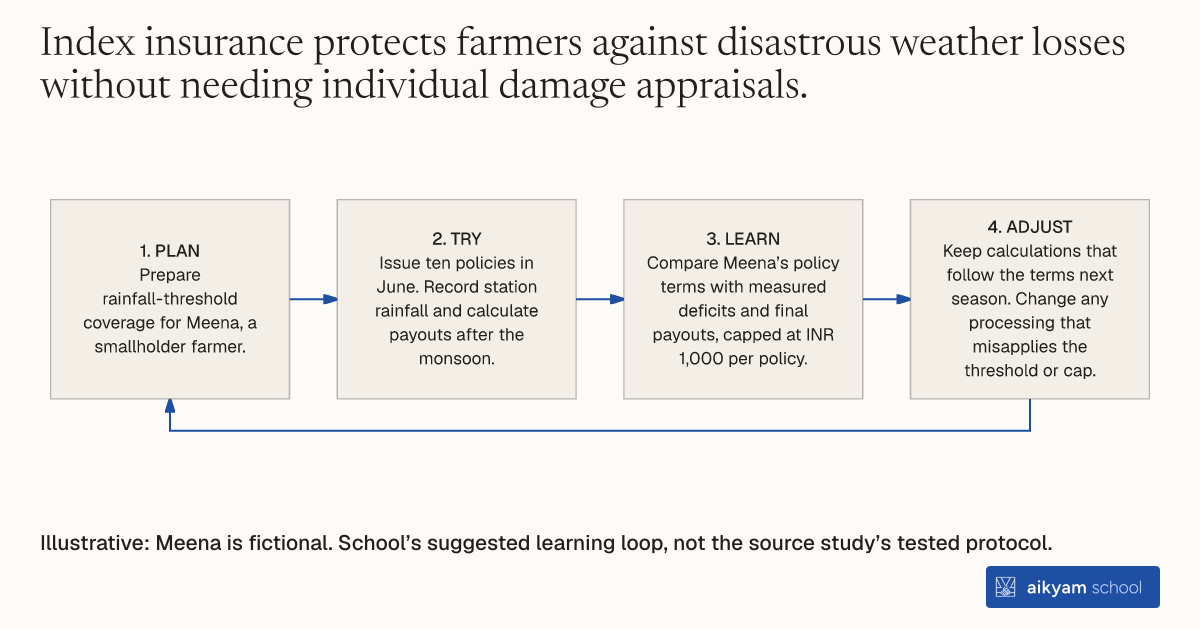
- Plan: Prepare rainfall-threshold coverage for Meena, a smallholder farmer.
- Try: Issue ten policies in June. Record station rainfall and calculate payouts after the monsoon.
- Learn: Compare Meena’s policy terms with measured deficits and final payouts, capped at INR 1,000 per policy.
- Adjust: Keep calculations that follow the terms next season. Change any processing that misapplies the threshold or cap.
Illustrative: Meena is fictional. School’s suggested learning loop, not the source study’s tested protocol.
See source →School’s suggested, untested loop. Observe policy delivery, station rainfall and payout calculations. This suggested loop does not establish crop-choice effects.
How
When to use
Rainfall deficits during the monsoon season create major income risks for smallholder farmers. Uninsured growers cope with weather risk by planting traditional, low-return crops instead of profitable cash crops. Distribute index insurance policies at the start of the planting season to help vulnerable farmers absorb weather shocks and shift production toward higher-return crops.
Provide rainfall index insurance policies to smallholder farmers at the onset of the monsoon season.
- Identify smallholder farming households in drought-prone rural agricultural communities.
- Design rainfall index policies that trigger cash payouts when local weather station measurements show rainfall during the sowing period falling below minimum growth thresholds.
- Issue ten rainfall insurance policies per household at the start of the monsoon season in June.
- Set payout amounts based on the size of measured rainfall deficits, up to a maximum cap of INR 1,000 per policy.
- Collect weather data throughout the June to November monsoon season across local automated weather stations.
- Calculate final payouts after the monsoon season ends based on recorded rainfall deficits.
Why it works
Removing catastrophic risk gives growers the safety needed to allocate land toward profitable cash crops.
Example
Researchers provided ten rainfall index insurance policies with a market value of INR 1,000 to smallholders in Andhra Pradesh, India, in June 2009. Uninsured comparison farmers received a promised INR 350 payment to control for wealth effects. Insured farmers increased their likelihood of planting cash crops by 6 percentage points and devoted 0.5 more acres to high-value cash crops like castor and groundnut.
About the study
Participants
1,479 small farming households across 45 villages in Andhra Pradesh, India; average household size 5.35 members, household head average age 49.6 years (91% male, 54% with no formal schooling).
Study Design
Randomized Controlled Trial (RCT); half the sample randomly received ten free rainfall index policies worth INR 1,000 in June 2009, while the control group received a promised fixed payout of INR 350 to control for wealth effects.
Results
Provision of insurance increased the likelihood of planting cash crops by 6 percentage points (a 12 percent increase from a 45 percent baseline) and increased land allocated to cash crops by 0.5 acres (a 27 percent increase from a 2-acre baseline).