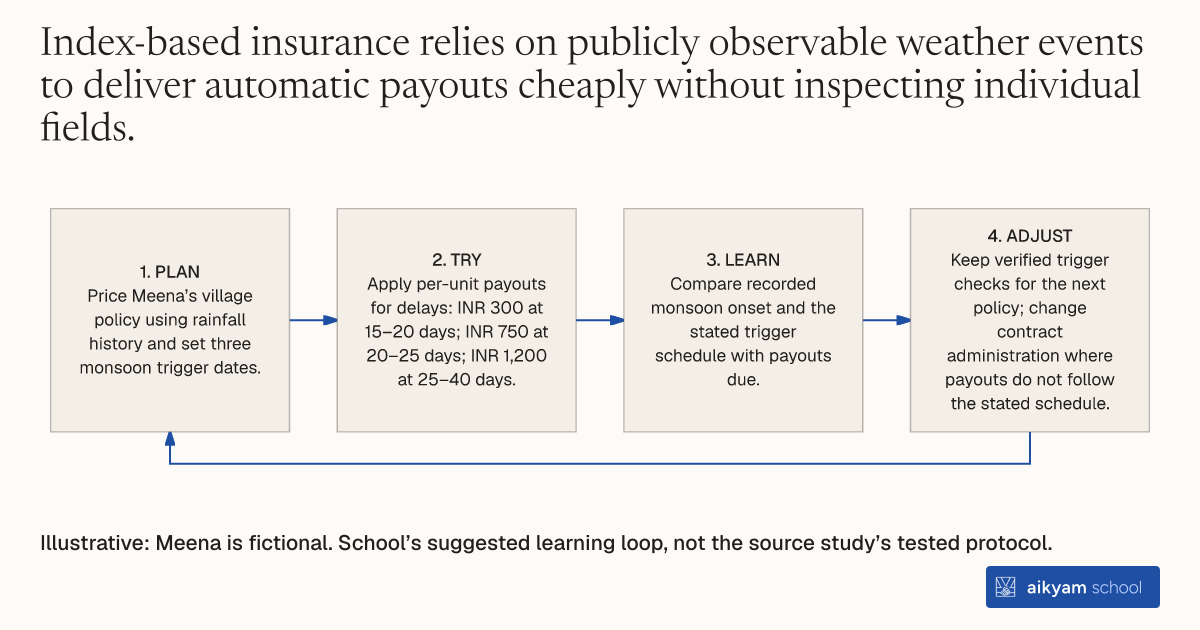
Try, learn and adjust
Check delayed-monsoon payout triggers
- Plan: Price Meena’s village policy using rainfall history and set three monsoon trigger dates.
- Try: Apply per-unit payouts for delays: INR 300 at 15–20 days; INR 750 at 20–25 days; INR 1,200 at 25–40 days.
- Learn: Compare recorded monsoon onset and the stated trigger schedule with payouts due.
- Adjust: Keep verified trigger checks for the next policy; change contract administration where payouts do not follow the stated schedule.
Illustrative: Meena is fictional. School’s suggested learning loop, not the source study’s tested protocol.
See source →School’s suggested, untested loop. Observe monsoon timing, trigger dates and per-unit payouts; the diagram adds no rule for overlapping boundary days.
How
When to use
Low-income farming households dependent on rainfall face severe income drops when the monsoon arrives late. Traditional agricultural insurance requires expensive monitoring of individual field yields. Index-based rainfall insurance with progressive trigger dates provides affordable financial protection against delayed planting seasons for rural farmers and agricultural laborers.
Design a multi-stage weather index insurance contract that distributes payouts across progressive monsoon delay thresholds.
- Calculate village-specific insurance prices based on historical rainfall data and monsoon delay risks.
- Set three distinct trigger dates during the monsoon season to monitor delayed onset.
- Issue a first payout of INR 300 (US\$6.99) per unit if the monsoon arrives 15 to 20 days late.
- Issue a second payout of INR 750 (US\$17.48) per unit if the monsoon arrives 20 to 25 days late.
- Issue a third payout of INR 1,200 (US\$27.97) per unit if the monsoon arrives 25 to 40 days late.
Why it works
Tiered trigger dates match progressive crop losses as delayed rainfall persists through the planting season.
Example
Researchers partnered with the Agricultural Insurance Company of India to offer delayed-monsoon contracts to farmers and agricultural laborers across 42 intervention villages in India at an average price of INR 145 (US\$3.38) per unit. Roughly 40 percent of visited households purchased insurance, and 38 percent of buyers purchased multiple units.
About the study
Participants
4,677 households across 63 villages in Tamil Nadu, Andhra Pradesh, and Uttar Pradesh, India.
Study Design
Randomized evaluation across 63 villages, randomly assigning 42 villages to receive marketing visits for a multi-stage rainfall contract and 21 villages to a comparison group.
Results
Cutting the insurance price in half increased take-up probability by 17.6 percentage points, while availability of insurance led rice farmers to plant higher-risk, higher-yielding crop varieties.